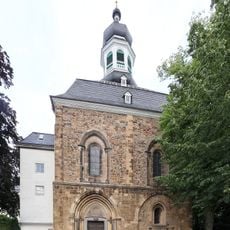
Deutsches Klingenmuseum Solingen, Cutlery and edged-weapon museum in Gräfrath, Solingen, Germany
The Deutsches Klingenmuseum is a museum in a restored monastery building that displays objects related to the history of cutting tools and weapons. The collection ranges from Bronze Age tools to swords and modern cutlery, showing the evolution of this craft across several millennia.
The museum began in the early 20th century as a technical school collection and later became the most important institution for documenting this craft tradition. Its move to the former monastery building in the 1990s marked its evolution into a national center for blade studies.
Gräfrath was a pilgrimage site from the 13th century, drawing crowds to the Augustinian convent where a Marian icon was said to work miracles. A bone splinter of Saint Catherine of Alexandria, acquired around 1309, was reported to release wonder-working oil between 1312 and 1323; the glass flask is still shown. This church treasure, among the most important in the Archdiocese of Cologne, is displayed in the museum.
The museum occupies the converted buildings of the former Gräfrath convent of Augustinian choir nuns, remodelled for museum use by architect Josef Paul Kleihues and in use since 1991. The new permanent exhibition Me fecit Solingen on the upper floor opened on 1 December 2024. In a small separate room, visitors can try fencing with real weapons — sabre, rapier and sword.
The museum holds the world's largest cutlery collection, acquired through two large purchases. Since 1991 it has occupied the former Gräfrath convent of Augustinian choir nuns, rebuilt for the museum by Josef Paul Kleihues. On the grounds stand sculptures such as Amir Sharon's Der Schritt (1995) and Wolfgang Körber's Der Zustand der Schere vor ihrer Erfindung (2012).
The community of curious travelers
AroundUs brings together thousands of curated places, local tips, and hidden gems, enriched daily by 92,728 contributors worldwide.