Neuerburg, Medieval castle ruin in Niederbreitbach, Germany
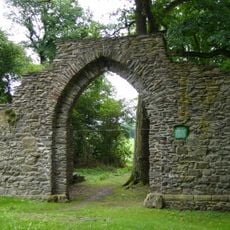
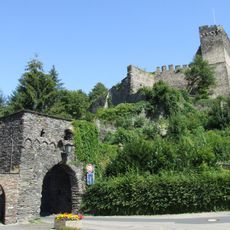
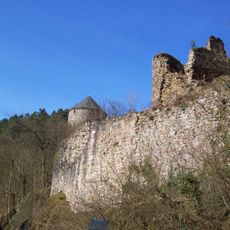
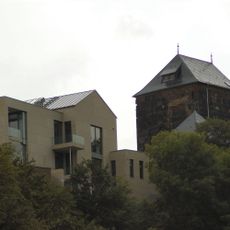
Neuerburg is a ruined hilltop castle on a steep cliff above the Fockenbach, about 2.5 km northeast of Niederbreitbach. Its five-sided residential tower, with three storeys preserved, is considered a prototype of Staufen castle-building; the ring wall shows late 12th-century masonry, and the outer bailey dates from around 1300.
Ludwig II of Thuringia had Neuerburg built around 1170 (between 1160 and 1180) as a prototype of a Staufen castle. In 1218 a noble family named itself after it, and in 1250 Countess Mechthild of Sayn gave the castle to the Archbishopric of Cologne. From 1290 an Amt Neuerburg was named after it, often pledged; decay began in the 17th century and before 1850 the Princes of Wied had the remaining buildings demolished. In 1945 American troops shelled the ruin, hitting it with about 60 grenades.
The name comes from the noble family of the Countess Mechthild of Sayn, who called itself after the castle from 1218 and occasionally stayed there after her husband's death. She gave the castle to the Archbishopric of Cologne in 1250. Legends of the Fockenbachtal tell of a monastery, a glassworks, a hidden treasure and a princess on the Neuerburg.
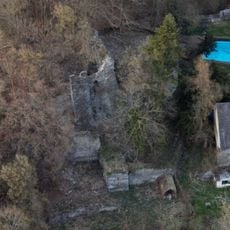
The ruin stands about 2.5 km northeast of Niederbreitbach at roughly 250 m above sea level, on a cliff above the left bank of the Fockenbach. It is privately leased and closed to hikers and visitors, so only an exterior viewing is possible. A reconstruction model is on display in the village museum of Niederbreitbach.
The ruin is privately leased by a Niederbreitbach resident who, in the second generation, has made its renovation a life's task; the site remains owned by the princely house of Wied. A reconstruction model is on display in Niederbreitbach's village museum.
The community of curious travelers
AroundUs brings together thousands of curated places, local tips, and hidden gems, enriched daily by 94,259 contributors worldwide.