Wiedtal Bridge, Railway bridge in Rhineland-Palatinate, Germany
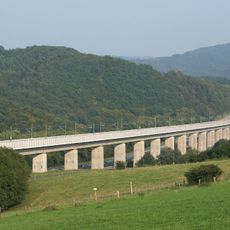
The Wiedtal Bridge is a 387 m long, two-track railway bridge on the Cologne–Rhine/Main high-speed line. Its prestressed concrete deck is a six-span continuous girder with a single-cell hollow box and inclined webs, carried by rectangular piers up to 45 m high. At 53 m, it is the highest bridge on the line, spanning the Wied river, the L255 and K33 roads, and the former Linz–Flammersfeld railway.
Construction was completed in 1999 as part of the expansion of rail connections between Cologne and Frankfurt. Since then it has enabled faster train service along one of Germany's busiest transport routes.
The bridge carries the Cologne–Rhein/Main high-speed line, whose trains are designed for 300 km/h. Its six spans of 62.77 m and 4 × 65.44 m match the field widths of the two parallel A3 motorway bridges just to the east, so rail and road crossings line up across the Wied valley. Noise barriers 2.5 m high stand on both sides.
The bridge crosses the Wied, the L255 state road, the K33 district road and the former Linz–Flammersfeld railway line; the A3 motorway runs parallel to the north on two road bridges. The structure is 387 m long and 53 m high, with 2.5 m noise barriers on both sides. The Ammerichtunnel (755 m) lies directly to the south, the Hallerbachtalbrücke (992 m) to the north.
The deck was launched by the incremental launching method, the only bridge in contract section A and one of three on the whole line built this way. Segments 32.77 m long were pushed out weekly from a casting pit at the Cologne abutment, uphill and without temporary supports, behind a 40.5 m launching nose.
The community of curious travelers
AroundUs brings together thousands of curated places, local tips, and hidden gems, enriched daily by 94,225 contributors worldwide.