Drususbrücke, Medieval stone bridge in Bingen am Rhein, Germany.
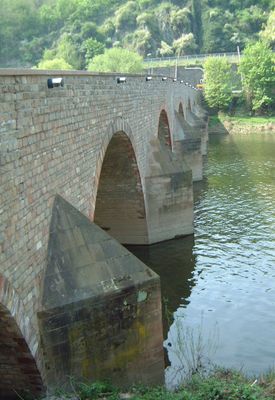
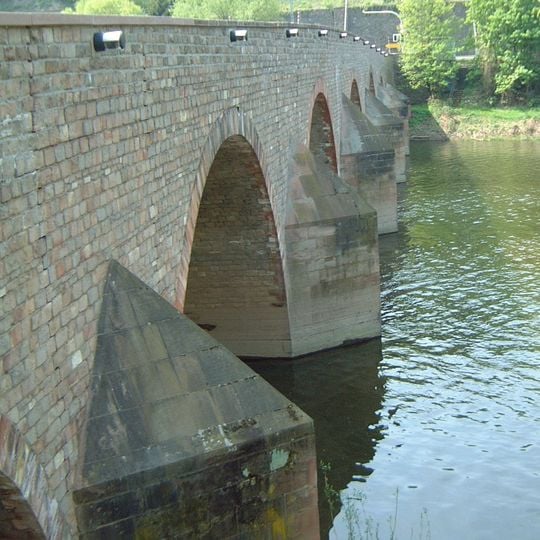
The Drususbrücke is a stone arch bridge over the Nahe at Bingen am Rhein, with six visible arches and a total length of 126 metres; the spans measure between 12.5 and about 15 metres. Its piers are built of red sandstone blocks fitted with cutwaters on the upstream side, and the deck, once laid in rough stone, is now surfaced with quartz porphyry. The roadway rises slightly towards the middle.
The Drususbrücke is the only surviving Roman bridge in Bingen. Its first structure, probably of wood, dates to the reign of Vespasian (69–79 AD). The arch nearest the left bank of the Nahe was destroyed when the Prussian Nahetalbahn railway was built in 1859. Six arches were blown up in 1945 and rebuilt in 1951–1952 with stones recovered from the river; the bridge was restored in March 2006.
The bridge's name recalls the Roman general Drusus, though the oldest surviving structure dates to the era of Vespasian. In the arch on the right bank of the Nahe, a small Romanesque chapel is set into a vaulted recess with windows and an east-facing apse; its present access was built in the 19th century.
The bridge carries the road between Bingen and Bingerbrück, about 1,200 m upstream from where the Nahe meets the Rhine. The arch nearest the left bank was removed for the Nahetalbahn railway in 1859, so the crossing now has six arches. Look for the small Romanesque chapel set into the arch on the right bank; its present entrance dates from the 19th century.
A small Romanesque chapel is set into a hollow in the rock beyond the eastern abutment, with a ribbed vault, windows and an east-facing apse; its present access dates from the 19th century. Three hollows lie above the slate rock before the first pier.
The community of curious travelers
AroundUs brings together thousands of curated places, local tips, and hidden gems, enriched daily by 94,448 contributors worldwide.