Rinsleyfelsen, natural monument
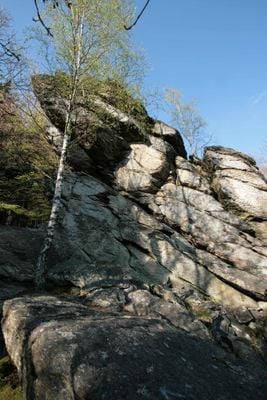
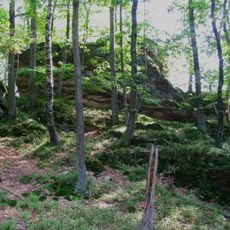
Rinsleyfelsen is a rock formation that rises prominently above the surrounding trees on the southern slope of Rinsenberg, near the village of Saalhausen in Lennestadt. The main outcrop stands approximately 15 to 20 meters high with a jagged, rough surface and features a summit cross visible from a distance.
The main rock consists of Lower Devonian ash and crystal tuffs, formed by volcanic activity on the floor of a sea about 400 million years ago. It belongs to the Lower Harbecke beds, marked by two thin keratophyre tuff layers. Below the crag, a slope of broken massive stone blocks extends down to about 510 metres, indicating the formation's original extent.
The name Rinsley, also Rinsleie, is used locally for the rock; the summit cross on the highest crag is the goal of walks from Saalhausen via the X18 trail toward Hoher Lehnberg. In March 2019 Sauerland-Tourismus presented the rock at the ITB in Berlin as one of 43 "Seelenorte" hiking destinations in South Westphalia.
The ascent is on foot only: either from the Gleietal valley through the Spinkackersiepen between Bauernhagen and Herrscheid up to the saddle, or from Saalhausen along the X18 trail toward the Hoher Lehnberg. The rock is climbable and secured with a handrail; the summit cross stands at 559.2 m.
In March 2019, Sauerland-Tourismus presented the Rinsleyfelsen at the ITB tourism fair in Berlin as one of 43 "Seelenorte" (places of the soul) in South Westphalia, chosen as especially popular hiking destinations. The rock is climbable and secured with a handrail; its summit cross can be seen from the Rothaargebirge ridge south of the Lenne.
The community of curious travelers
AroundUs brings together thousands of curated places, local tips, and hidden gems, enriched daily by 94,190 contributors worldwide.