Dyckburg-Kirche, Religious monument in Münster, Germany.
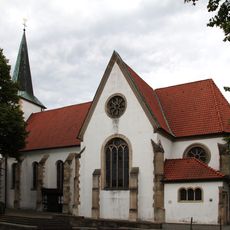
St. Mariä Himmelfahrt, known as the Dyckburg-Kirche, stands in Münster's Dyckburg district on the grounds of a former castle, of which only fragments remain. Its core is the small Loreto Chapel consecrated in 1740, modelled on the chapel in the Italian pilgrimage site of Loreto; at the end of the 19th century the Münster architect Rincklake added a circular church space and a neo-Baroque choir.
The church stands on the grounds of a former castle used by the Bishop of Münster for military purposes; Bishop Franz von Waldeck had his headquarters there during the 1534–1535 siege of Anabaptist-held Münster. Around 1700 Dompropst Ferdinand von Plettenberg commissioned Baroque architect Johann Conrad Schlaun to build a manor with a small chapel, consecrated in 1740 and modelled on the chapel at Loreto. At the end of the 19th century the Münster architect Rincklake added a circular church space and a neo-Baroque choir. From 1949 to 2008 it was the parish church of the small Dyckburg community, since 2010 part of the parish of St. Petronilla in Münster-Handorf, and in June 2025 its sale to the Romanian Orthodox Metropolis as of 1 December 2025 was announced.
The entrance area is still called the Loreto Chapel, after the model for the 1740 chapel: a building in the Marian pilgrimage site of Loreto in Italy. From 1949 to 2008 the church was the parish church of the small Dyckburg community; since 2010 it has belonged to the parish of St. Petronilla in Münster-Handorf.
The church stands in the Dyckburg district north-east of Münster's centre, on the grounds of the former castle whose fragments remain beside it. It belongs to the parish of St. Petronilla in Münster-Handorf, so service times follow that parish's schedule. A pipe organ was removed in late 2011 during renovation and replaced by an electronic Ahlborn PRAELUDIUM III; a return to a pipe instrument is being pursued.
The entrance area is still called the Loreto Chapel, after the Marian pilgrimage site of Loreto in Italy, which served as the model for the chapel consecrated in 1740. The pipe organ built in 1966 by Alexander Schmieding, with 22 stops on three manuals and pedal, was removed at the end of 2011 during a renovation and replaced by an electronic Ahlborn PRAELUDIUM III instrument.
The community of curious travelers
AroundUs brings together thousands of curated places, local tips, and hidden gems, enriched daily by 93,667 contributors worldwide.