Liebfrauenkirche Recklinghausen, Gothic Revival parish church in Recklinghausen, Germany.
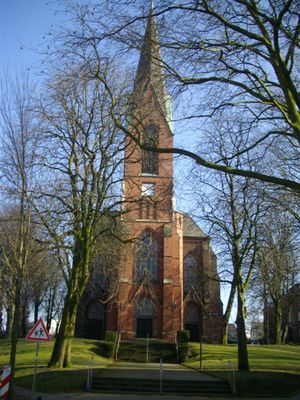
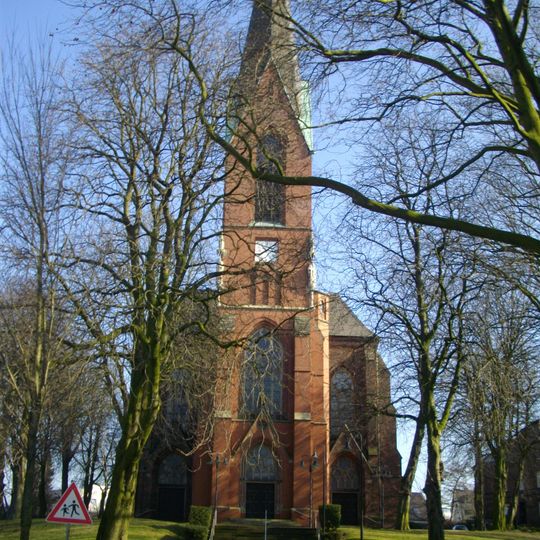
The Liebfrauenkirche is a red brick Gothic Revival church with a central square tower topped by a steep dark slate spire. The tower has paired pointed-arch windows and a clock face, and the lower flanking sections each have large pointed-arch windows and gabled rooflines. Inside, it is a three-aisled hall church with equal-height naves.
Mining at the General Blumenthal colliery from 1873 brought miners to the Dortmunder and Castroper Straßen, and the population growth led to a temporary timber-framed church consecrated on 9 October 1900. The architect Franz Lohmann designed the permanent church, begun in 1901 and consecrated on 19 October 1903. It has been a protected monument since 1987.
The church's name comes from its predecessor, a temporary timber-framed Rosenkranzkirche consecrated in 1900, whose popular name Liebfrauenkirche stuck. The Marienaltar in the right aisle shows Mary handing a rosary to Saint Dominic, tying the building to its Marian dedication. The five cast-steel bells of the Bochumer Verein, three from 1922 and two added in 1958, hang in the slender west tower.
The church stands on a rise at Castroper Straße 43, reached from Liebfrauenstraße by a driveway and from Rosenstraße by two flights of stairs. Of the five entrances, the front-left door was rebuilt as a step-free access for visitors with limited mobility. Inside, the three naves are of equal height, so the whole floor can be crossed at one level.
The tower's lower section is square and turns round toward the top; at 45 metres stand the apostle figures of Peter and Paul. The five cast-steel bells come from two generations: the three large ones (ais°, cis′, e′) were cast in 1922, the two small ones (fis′, gis′) added in 1958.
The community of curious travelers
AroundUs brings together thousands of curated places, local tips, and hidden gems, enriched daily by 94,518 contributors worldwide.