Kirchturm St. Andreas, Romanesque church tower in Bad Godesberg, Germany
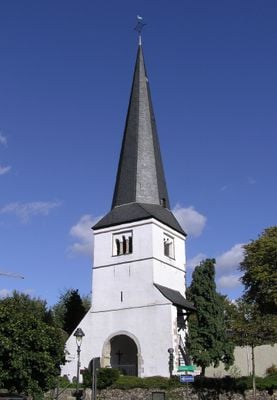
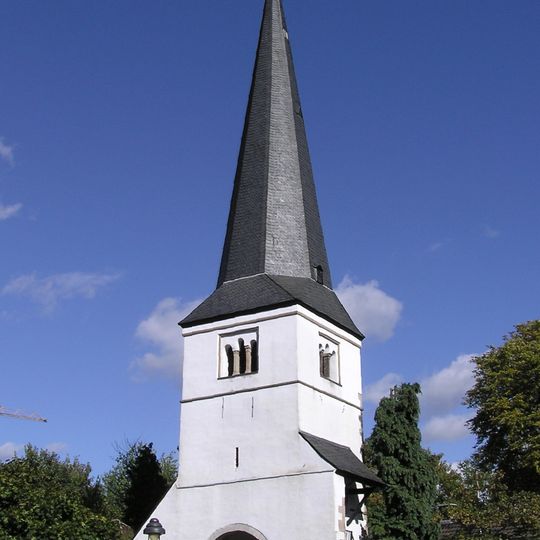
Kirchturm St. Andreas is the surviving Romanesque choir tower of the former parish church of St. Andreas in Rüngsdorf, first documented in 1131. The square tower has a white-plastered body with a horizontal band, a rectangular opening divided by two dark mullions, and a steep octagonal slate spire with small openings near its base. A small gabled roof projection extends from the lower right side, and a stone lamp stands at the lower left corner.
St. Andreas church in Rüngsdorf was first documented on 31 March 1131, when Pope Innocent II confirmed the Bonn Cassius Foundation's rights to the ecclesiam Rinnigestorph. The surviving Romanesque choir tower dates from around 1200. When the new parish church was built between 1900 and 1902, the old church was to be demolished entirely, but lack of money for a new bell tower led to keeping the old tower, which still serves as the bell tower.
The room above the now-open apse was used to store the parish records and fire-fighting equipment, and it also hosted the council meetings. The tower room has arrow slits, which may indicate that St. Andreas served as a fortified church. Since 1982 the tower has housed a memorial to the dead of wars and tyranny.
The tower stands in Rüngsdorf, a district of Bad Godesberg, next to the modern parish church built in 1900–1902. It can be viewed from the surrounding streets and the adjacent cemetery with its 17th- and 18th-century grave crosses and stone wayside cross. The interior is normally closed, but the tower is occasionally opened for guided visits on Tag des Offenen Denkmals.
The tower's upper room, above the now-open apse, was used to store the parish records and fire-fighting equipment and also served as the meeting room for the council. Arrow slits in the tower room suggest St. Andreas may have been a fortified church.
The community of curious travelers
AroundUs brings together thousands of curated places, local tips, and hidden gems, enriched daily by 92,806 contributors worldwide.