Handel monument, Bronze monument in Market Square, Halle, Germany.
The Handel Monument is a classicist bronze statue on the Marktplatz in Halle (Saale), unveiled in 1859. The 3.2-metre, 1500-kilogram figure of an older, corpulent Handel in period dress—coat, knee breeches, stockings, sword and a large curled wig—leans against a Rococo-style music stand on his right, where the score of Messiah lies. The statue stands on a 19-tonne marble pedestal above three granite steps.
A committee commissioned Berlin sculptor Hermann Heidel to design the statue in 1843, and the bronze was cast by Hermann Gladenbeck in 1859. The unveiling, planned for the 100th anniversary of Handel's death on 14 April 1859, was postponed because of Heidel's long illness and took place on 1 July 1859. The British royal house donated nearly a third of the total cost.
The monument's base carries the year 1741, marking when Handel composed Messiah. On its back is a relief of Saint Cecilia playing the organ, flanked by King David and Orpheus as representatives of sacred and secular music. The front reads simply HAENDEL 1685–1759; the rear inscription records that it was erected by his admirers in Germany and England in 1859.
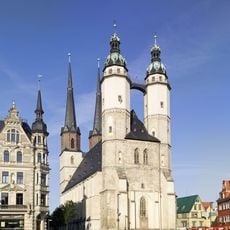
The monument stands on the Marktplatz, opposite the Marktkirche where Handel was baptized, and is reached on foot from the surrounding pedestrian zone. Three granite steps lead up to the marble pedestal, so the statue itself is not at ground level. The iron grille that once enclosed it was replaced in 1885 and later destroyed; its reconstruction remains debated in Halle.
The music stand beside the statue is carved with figures: Cecilia playing the organ on the back, David and Orpheus on the sides, and the year 1741 on the base, marking the year Handel composed Messiah. The rear inscription reads: Erected by his admirers in Germany and England, 1859.
The community of curious travelers
AroundUs brings together thousands of curated places, local tips, and hidden gems, enriched daily by 92,805 contributors worldwide.