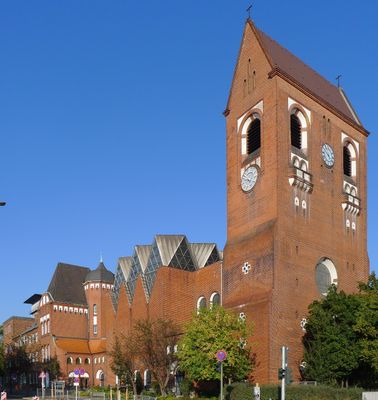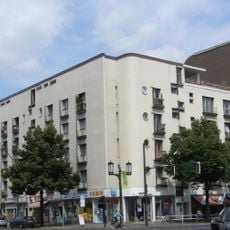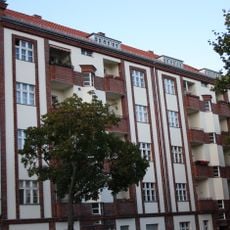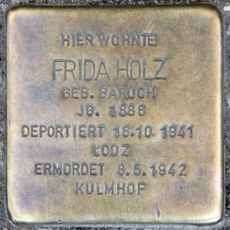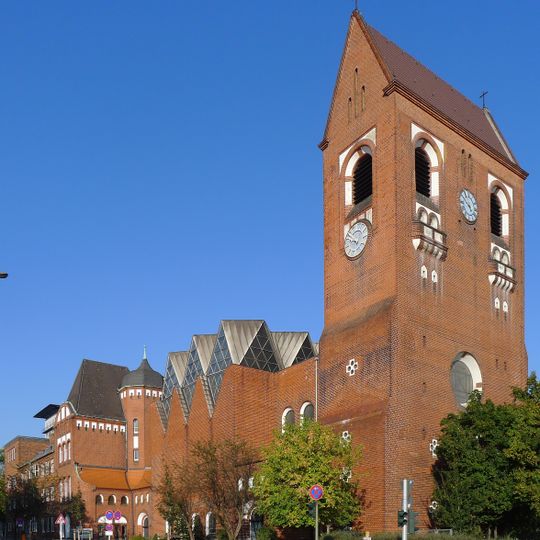
Epiphanienkirche, Protestant church in Berlin-Westend, Germany.
Epiphanienkirche is a Protestant church at Knobelsdorffstraße 72/74 in Berlin-Westend, built 1904–1906 to a design by Jürgen Kröger. The brick building with brown terracotta tiles is a cross-shaped central structure with a flat choir and a twin-tower front, each tower 40 metres high. Since the 1957–1960 rebuild by Konrad Sage, the interior is oriented north–south and covered by a new roof.
The Epiphanienkirche was built from 1904 to 1906 to a design by Jürgen Kröger, after Empress Auguste Viktoria chose its name in an architecture competition. The church burned out in May 1945; in 1953 Erich Ruhtz repaired the two 40-metre towers under a single steep saddle roof. Konrad Sage rebuilt the interior from 1957 to 1960 within the old outer walls, rotating the cross-shaped central space 90 degrees to a north-south axis.
Wall paintings in the interior depict Jesus Christ above the altar and illustrate biblical parables including the Good Samaritan and the Prodigal Son. These visual stories help visitors connect with the building's religious purpose through art.
The church stands at Knobelsdorffstraße 72/74 in Westend, near the old Luisenkirchhof; the twin-tower front faces the street, and the 1929–1930 parish house adjoins it. The site is reached from the surrounding residential streets, and the interior was reoriented north–south during the 1957–1960 rebuild, so the entrance side and the worship axis no longer coincide.
The church owes its name to Empress Auguste Viktoria, who picked "Epiphanienkirche" from the competition entries; because it was reached only over sandy paths from the northwest, locals called it the "Church on the Sand Hill". The 1904–1906 shell was finished in August 1905, and the final bill came to 470,000 marks against an estimate of 350,000.
The community of curious travelers
AroundUs brings together thousands of curated places, local tips, and hidden gems, enriched daily by 93,650 contributors worldwide.