Erlöserkirche, Gothic church in Detmold, Germany.
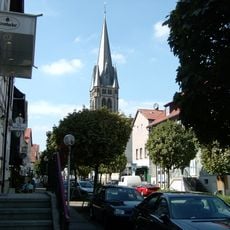
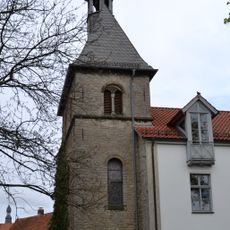
Erlöserkirche is a three-aisled late Gothic hall church of the Westphalian type, rebuilt after the town fire of 1547. Its rectangular choir faces east, and a square south tower, begun in 1564 and topped with a Renaissance helm in 1592, rises 46 metres. The interior, 24.7 metres wide and 18 metres long, is supported by two short, massive piers.
Founded around 800 as the mother church of the Theotmalli district, the church was first documented as St. Vitus Church. After the town fire of 26 January 1547 it was rebuilt in Gothic style; the south tower followed from 1564 to 1592, and two tower watchmen lived in it from 1596. In 1605 Count Simon VI introduced the Reformed confession, and the church received the name Erlöserkirche only in 1947.
The church was long called Marktkirche or Vituskirche; the name Erlöserkirche dates only from 1947. Since 1605 it has held the Reformed confession introduced by Count Simon VI, who filled vacant pastorates with Reformed clergy. The 1579 baptismal font's brass bowl carries a Low German inscription from Titus 3.
The church stands between Detmold's palace and market square, so it is easily reached on foot from the town centre. The 46 m tower with its 1592 Renaissance helm is the landmark to aim for. The interior is plain and low on seating, so a visit takes little time; the 1795 Oestreich organ on the west gallery is the main thing to look at inside.
The large bell, called Feuerglocke, was cast in 1568 by Hans Rabe and survived both world wars; it is the oldest bell in Detmold. Since 2005 a 1,200-kilogram peace bell from the Rincker foundry, sounding f′, has replaced the bell melted down in the First World War.
The community of curious travelers
AroundUs brings together thousands of curated places, local tips, and hidden gems, enriched daily by 93,095 contributors worldwide.