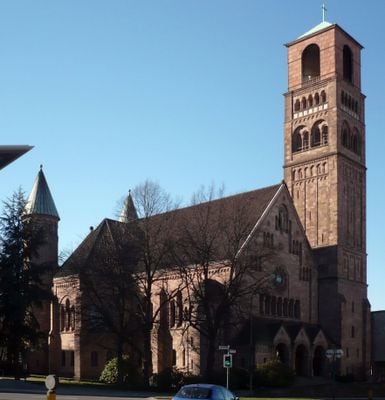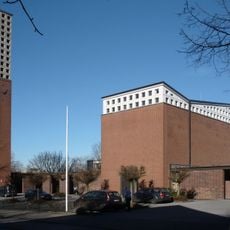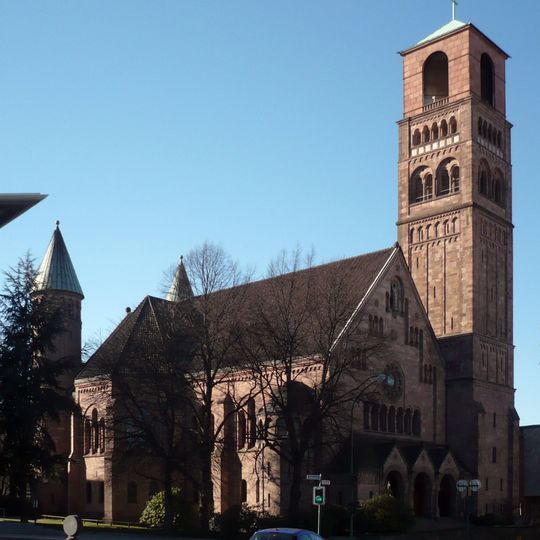
Erlöserkirche, Romanesque Revival church in Essen, Germany.
The Erlöserkirche is a neo-Romanesque hall church with a transept and a surrounding gallery, built from 1906 to 1909 to a design by Franz Schwechten. Its 50-metre length accommodates 1,200 people, 500 of them on the galleries. The facades are Ohlsbrücker sandstone on a Niedermendiger basalt lava base, and a broad flight of steps leads up to three column portals.
In 1896 the growing parish decided to build a new church and acquired the plot at the corner of today's Bismarck and Friedrich Ebert streets. The first plans by August Orth came to nothing; in 1904 Franz Schwechten, architect of the Kaiser Wilhelm Memorial Church in Berlin, took over. The foundation stone was laid on 31 October 1906, and the church was consecrated on 29 November 1909, with mosaics, bells and organ funded by Margarethe Krupp and Carl Funke. An Allied air raid on 5 March 1943 badly damaged it; rebuilding began in 1948/49.
The church hosts concerts by the Essener Bachchor and the choir "Gospel and more", alongside parish services. Its name comes from the statue of the Saviour in the topmost arch of the gable. The tower holds five bells, two of them former bells of the Protestant Marktkirche in Essen.
You can visit the church to view the architectural features or attend services, with regular opportunities to explore the building. Check the opening times in advance, as they vary depending on worship services and special events.
The two largest bells came from the Marktkirche: the 1842 Petit & Gebr. Edelbrock bell (1.51 m diameter, 2,310 kg, tone d1) and the 1812 Sartorius bell (1.15 m, 920 kg, tone f1), which once rang from the Marktkirche tower every evening at 9 pm.
The community of curious travelers
AroundUs brings together thousands of curated places, local tips, and hidden gems, enriched daily by 94,167 contributors worldwide.