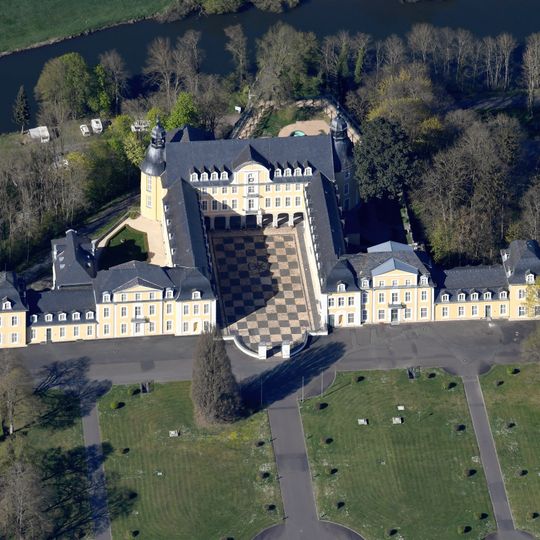
Schloss Oranienstein, Baroque palace in Diez, Germany
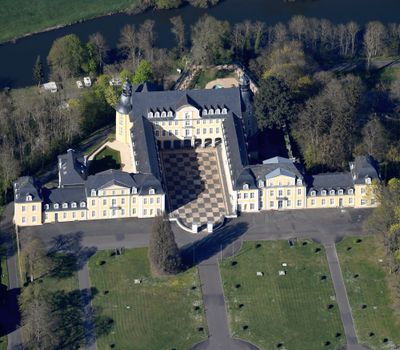
Schloss Oranienstein is a pale yellow Baroque palace in Diez, built 1672–1681 on the ruins of the Benedictine convent Dierstein. Its five-wing U-shaped plan, rebuilt by Daniel Marot from 1704 to 1709, encloses a checkerboard-patterned courtyard; the central block has a curved white canopy and a dark dome, with a taller domed tower on the left corner. The palace chapel on the first floor of the south-east wing has stucco by Eugenio Castelli and Antonio Gentone and a ceiling painting of Pentecost by Carlo Lodovico Castelli.
Princess Albertine Agnes had the palace built between 1672 and 1681, while later her daughter-in-law Princess Amalie carried out further expansions from 1704 to 1709. This building phase shaped the baroque style seen today.
The palace is one of four German castles named after the House of Orange, alongside Oranienburg, Oranienbaum and the vanished Oranienhof near Kreuznach; they were built for four sisters born into that house. Albertine Agnes, who commissioned Oranienstein as her widow's seat, banned witch burnings and drinking bouts in Diez and appointed a doctor and a free pharmacy. The Oranien-Nassau Museum opened here on 23 May 1962.
Visitors should register in advance by phone to join the guided tours, which provide access to selected palace sections. It works best to allow enough time to explore the rooms and historical collections at a leisurely pace.
The chapel's ceiling painting of the Pentecost miracle was long attributed to the Dutchman Jan van Dyk, but is actually by Carlo Lodovico Castelli, brother of the stuccoist Eugenio Castelli. The organ above the pulpit, in a Baroque case, was built in 1967 by Eduard Wagenbach with 25 stops on two manuals and pedal.
The community of curious travelers
AroundUs brings together thousands of curated places, local tips, and hidden gems, enriched daily by 94,056 contributors worldwide.