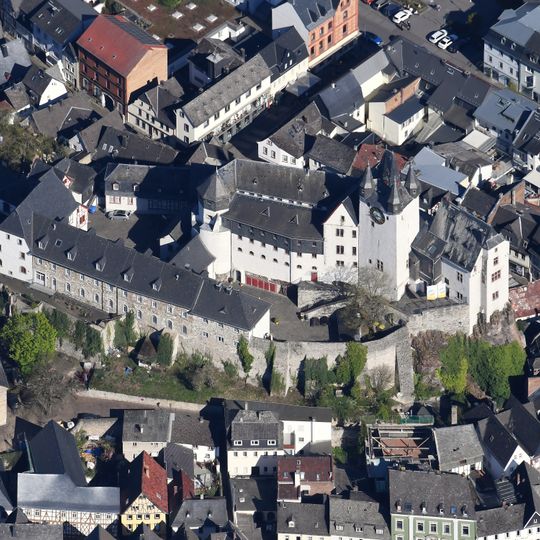
Diez Castle, Medieval castle in Diez, Germany
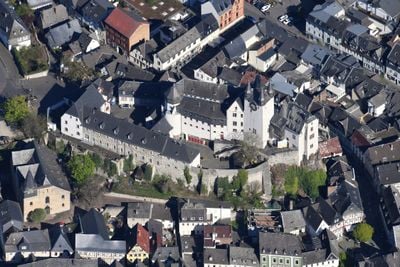
Diez Castle stands on a porphyry rock above the old town of Diez, where the Aar meets the Lahn. Its core is a four-storey bergfried, 10 by 10 metres, with a steep hipped roof and four corner turrets added around 1425, beside a three-storey south palas built in 1485. A large outer bailey with a 1581 gatehouse and timber-framed gable lies to the north-east, and grey and white masonry with slate roofs fills the courtyard.
The first castle on the porphyry rock above Diez is undocumented in date and builder; a Frankish post guarding the Aar ford is assumed by the 790 first mention of the settlement as Theodissa. The bergfried and palas were built in the second half of the 11th century, before 1073, by the Counts of Diez. In 1386 the line died out with Gerhard VII and the castle passed through his daughter Jutta to Adolf of Nassau-Dillenburg; the 1564 Treaty of Diez gave Nassau sole rule, and from 1778 to 1928 it served as a prison.
The castle was for centuries the seat of the Counts of Diez, and its outline still defines the town's skyline as seen from the valley below. Standing on the grounds, visitors can easily understand how such a position gave its lords control over the river crossing and the roads beneath.
The site is reached on foot, and the climb up the hill calls for comfortable shoes as the ground can be uneven in places. The walk up rewards visitors with an open view over the Lahn valley and the town rooftops below.
The castle's prison era left workshops inside its walls: from the late 18th century inmates practised trades, most notably working Lahn marble. The prison operated until 1928, though from 1910 it was gradually moved to a new building in Freiendiez. Since 1953 a youth hostel has occupied the former cell wing and workhouse in the western outer bailey.
The community of curious travelers
AroundUs brings together thousands of curated places, local tips, and hidden gems, enriched daily by 93,897 contributors worldwide.