Solbad Wittekind, Heritage spa complex in Halle, Germany.
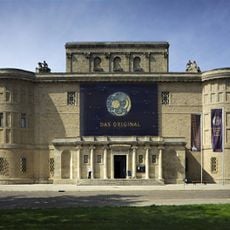
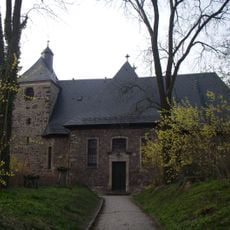
Solbad Wittekind is a spa complex in Halle's Giebichenstein district, rebuilt from 1923 to 1925 to designs by city building director Wilhelm Jost. Its central bathhouse, modelled on Baroque pleasure palaces, sits on a U-shaped plan with high hipped roofs and two two-storey end wings; the half-oval opens onto a park, and an oval central pavilion with large round-arched windows forms the main entrance. The 1855 Gesellschaftshaus by Friedrich August Stüler is a two- to three-storey Neorenaissance stucco building closing the west end.
Salt extraction at Giebichenstein dates to prehistoric and medieval times; the spring was filled in after the Neuwerk monastery abandoned salt boiling in the 13th century. In 1846 the merchant Heinrich Thiele reopened the old well and built a brine spa on the site of the Schmohlsche Garten tavern, advised by Peter Krukenberg and Richard von Volkmann. Its heyday ran from 1850 to 1880; the city bought the grounds in 1909 and took over the spa on 30 December 1913. After decades without repairs and a decline in brine quality, the well was deepened to a 3% brine and a new bathhouse, administration building and colonnades were built from 1923 to 1925 to designs by city building director Wilhelm Jost.
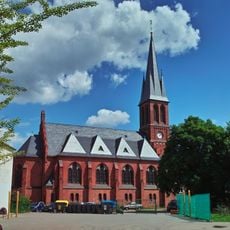
The sculptor Gustav Weidanz, then teaching at Burg Giebichenstein, made the brine well surround and two green ceramic portal figures for the 1925 bathhouse entrance; neither survives today. The colonnades, rebuilt during the 2012–2017 restoration, now house the kindergarten of the Protestant Bartholomäus congregation.
The complex lies on Wittekindstraße at the foot of the Reilsberg, directly bordering the Bergzoo to the north; Reichardts Garten is across the street to the south. The bathhouse now serves as a health centre with therapy facilities, while the colonnades, dismantled and rebuilt for structural reasons, house the Protestant Bartholomäus parish kindergarten. The grounds were renovated between 2012 and October 2017.
The brine spring that fed the baths was capped and its well is now lost; the sculptor Gustav Weidanz, who taught at Burg Giebichenstein, made the well surround and two green ceramic portal figures for the bathhouse entrance, and none of these survive today.
The community of curious travelers
AroundUs brings together thousands of curated places, local tips, and hidden gems, enriched daily by 93,721 contributors worldwide.