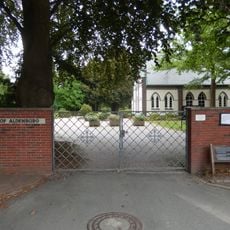
St.-Jakobi-Kirche, Lutheran church in Neuende, Wilhelmshaven, Germany.
St.-Jakobi-Kirche stands on a 3 m high terp in the coastal marsh, now within the built-up area of Wilhelmshaven-Neuende. Its Romanesque chancel of granite blocks, with a brick upper apse, is the oldest surviving part; the 14th-century brick nave has round-arched and seven pointed-arch windows, and the late Gothic tower was added to the west end in the first third of the 16th century.
The Romanesque chancel of granite blocks, with a brick upper apse, was built in the early 13th century and is the last remnant of the first church here, possibly destroyed in the Second Marcellus Flood of 1362. The brick nave followed in the 14th century, and the late Gothic tower was added to its west end in the first third of the 16th century. Traces of the first nave were found in investigations of 1973/1974.
Papal documents name it "capella sancti Jacobi zu Insmerhave", later "zu Nieyennede", tying the parish to Saint James. The pulpit of 1647, carved in oak with a canopy, walkway and portal, is attributed to Onno Dircksen, a former journeyman in Ludwig Münstermann's workshop; the date ANNO 1647 is cut into the underside of the pedestal beneath the figure of the Risen Christ.
Check whether visits are possible, as access can vary depending on services and events. Contacting the parish office helps confirm opening times and visiting conditions.
The tower holds two bronze bells cast in 1969 by the Otto foundry in Hemelingen near Bremen, sounding f' and as'; a space for a third bell remains empty. Earlier bells were lost, cracked or surrendered in wartime. The churchyard around the building keeps well-preserved historic gravestones and burial vaults.
The community of curious travelers
AroundUs brings together thousands of curated places, local tips, and hidden gems, enriched daily by 93,668 contributors worldwide.