Jewish cemetery in Hamburg-Altona, Jewish burial ground in Altona, Germany.
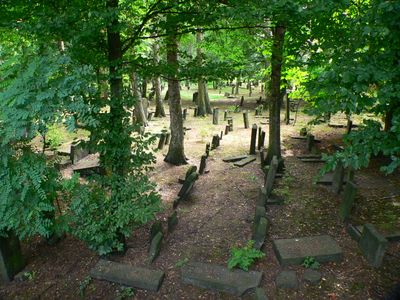
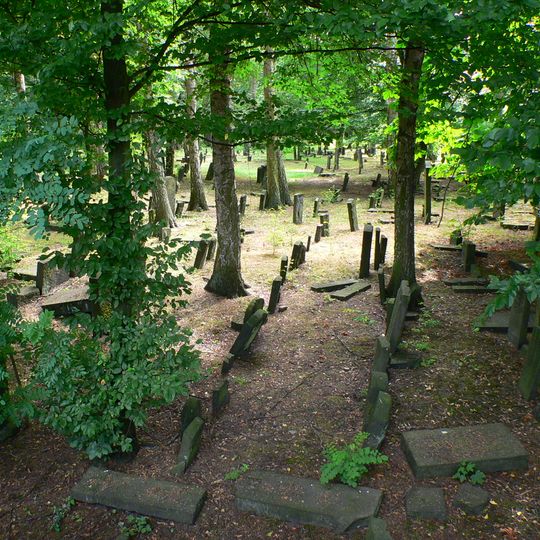
The Jewish cemetery in Hamburg-Altona, also called Jüdischer Friedhof Königstraße, covers 1.9 hectares and holds about 7,600 preserved tombstones out of 8,474 counted at its 1869 closure. Sephardic graves are flat slabs or tent-shaped stones, while upright Ashkenazi stones bear carvings such as a jug, blessing hands or a hand with a quill. The stones are marble, limestone or sandstone.
Portuguese Jews from Hamburg bought land on the Altona Heuberg on 31 May 1611; the first burial took place in 1616. The Ashkenazi community acquired an adjacent plot, and its section was enlarged in 1668, 1710, 1745 and 1806. Officially closed in 1869, the cemetery saw exceptions until 1871 and, in the Portuguese part, until 1877.
The burial sections display different artistic traditions between the communities: Sephardic tombs feature ornamental carvings, while Ashkenazi stones maintain simpler designs. These visual contrasts show how distinct religious customs coexisted within this shared space.
The cemetery can be visited on specific days, and guided tours are available to help understand the history and inscriptions better. It is best to check opening times in advance, as these may vary seasonally.
The Eduard Duckesz Fellowship, funded by the Hermann Reemtsma Stiftung, allowed the cemetery to be filmed gravestone by gravestone in 2013 by Spanish filmmaker Ainhoa Montoya Arteabaro, while photographer Jürgen Faust made a systematic photographic record. The fellowship is named after Eduard Duckesz; there is no Duckesz house on the grounds.
The community of curious travelers
AroundUs brings together thousands of curated places, local tips, and hidden gems, enriched daily by 92,978 contributors worldwide.