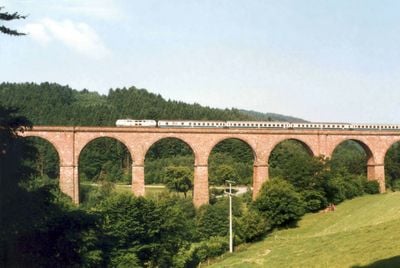
Himbächel-Viadukt, Railway viaduct in Hetzbach, Germany.
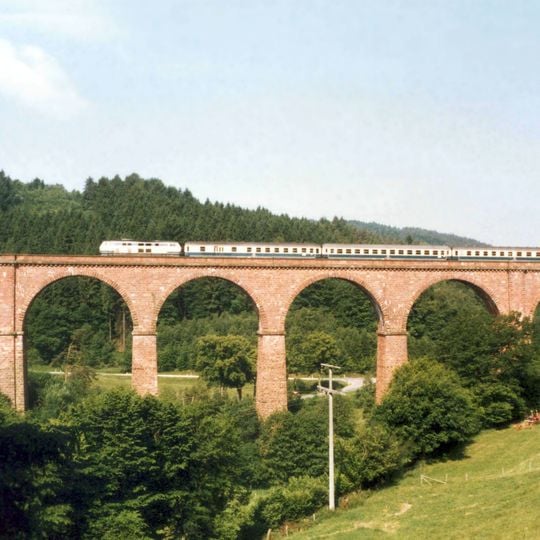
Himbächel-Viadukt is a sandstone railway bridge in Hetzbach, in the Odenwald region, that crosses the Himbächel valley over a length of 250 meters on ten arches. It rises to 43 meters at its tallest point, linking two hillsides to carry rail traffic across the valley.
Designed by engineer Justus Kramer, the viaduct was built from May 1880 to November 1881 by Karl Weißhuhn's firm for the Hessian Ludwigsbahn, costing 343,615 marks, and opened in May 1882. Near the end of World War II, villagers removed charges from the two central piers after the soldiers had marched off, preventing demolition.
The bridge is masonry of local Buntsandstein, a red-brown sandstone; the piers' cores are rubble stone and the foundations were poured in concrete. Its ten arches were built between 1880 and 1881 on wooden centring, and the structure has been a Hessian cultural monument; on 10 September 2010 it was named a Historisches Wahrzeichen der Ingenieurbaukunst in Deutschland.
The viaduct can be visited at any time of year, and walking paths through the valley lead directly under the arches. Those looking for a full view of the structure will find the best spots along the valley trails on either side of the bridge.
After dark, the viaduct is lit up and can be clearly seen from the nearby Bundesstrasse 45 road. This lighting makes the old stone structure visible as a landmark in the landscape even at night.
The community of curious travelers
AroundUs brings together thousands of curated places, local tips, and hidden gems, enriched daily by 94,417 contributors worldwide.