Schloss Arnsberg, Medieval castle ruins on Schlossberg hill in Arnsberg, Germany.
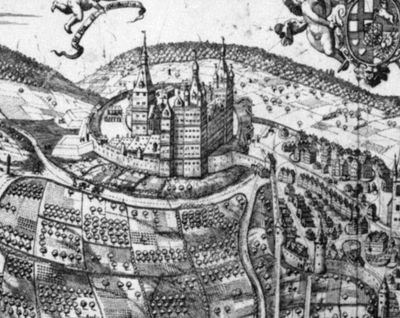
Schloss Arnsberg is a ruin on the 256 m Schlossberg above Arnsberg, North Rhine-Westphalia. A grey stone curtain wall with a short stretch of crenellation stands several metres high above a grassy slope; behind it a grassed terrace holds low, roofless foundation walls and a small square stone structure. The site was rebuilt in Renaissance style around 1575 and in Baroque style from 1739 under Johann Conrad Schlaun, and was destroyed in 1762 during the Seven Years' War.
The castle was built around 1100 and served as a residence for the family ruling the region. After roughly 300 years, ownership changed and it became an administrative center for a larger power.
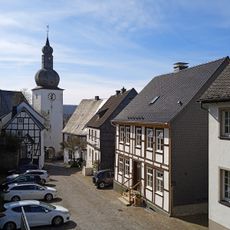
The castle gave its name to the town of Arnsberg that grew from the small settlement of castle men and craftsmen below it. From 1368 the archbishops of Cologne, as dukes of Westphalia, held court here on visits, and the Landdrost governed the Duchy of Westphalia from the castle; some Landtage assemblies met within its walls.
The ruin stands on the 256 m Schlossberg above Arnsberg, reached on foot; the terrain is uneven, with the curtain wall, grassy terrace and low foundation walls of the roofless complex to cross. Sturdy shoes help on the slopes and masonry edges.
Excavations in recent years have uncovered stone walls older than the documented construction history, showing that structures stood here before written records. These findings suggest the site has a longer past than scholars once thought.
The community of curious travelers
AroundUs brings together thousands of curated places, local tips, and hidden gems, enriched daily by 94,039 contributors worldwide.