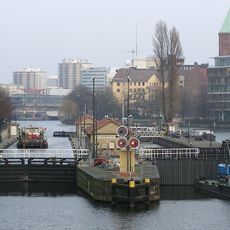
Inselbrücke, Stone footbridge in Berlin-Mitte, Germany.
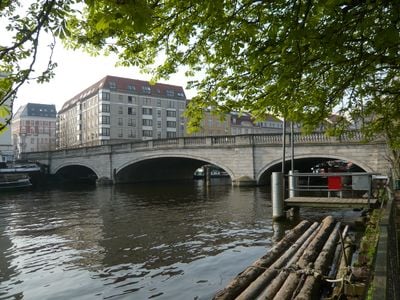
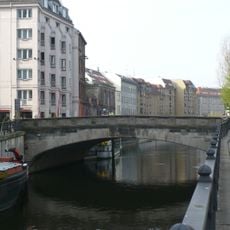
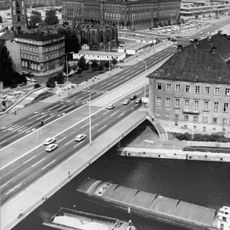
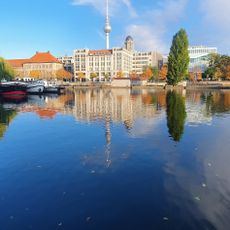
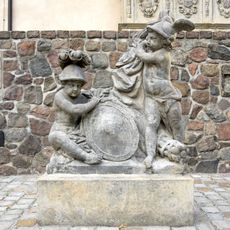
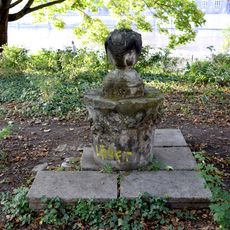
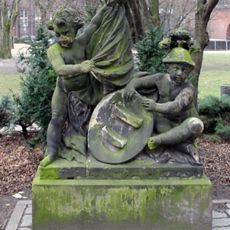
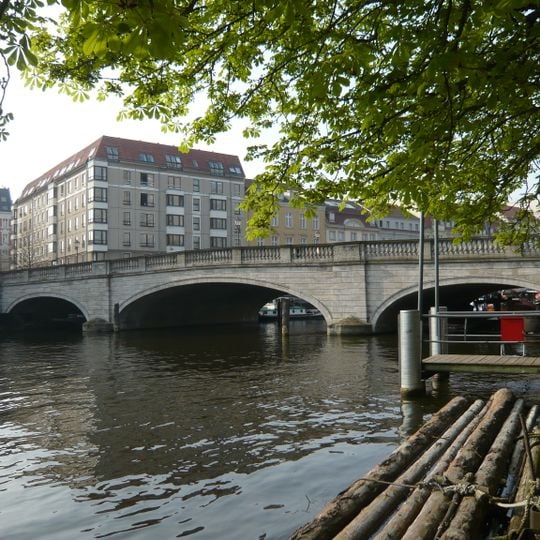
The Inselbrücke is a stone arch bridge over the western arm of the Spree, the first bridge in the river's course at the Spreeinsel. Built in 1912–1913 to plans by Ludwig Hoffmann and Stadtbaurat Krause, it has three clinker brick vaults with spans of 11, 18 and 11 metres, faced with Kirchheimer Muschelkalk and neo-baroque balustrades. Four obelisks flanked by putti stand over the middle piers.
A wooden bridge with a flap passage for shipping was built here in 1693, about 5 m wide, and served as a river crossing for some 200 years. The present stone arch bridge, designed by Ludwig Hoffmann and Stadtbaurat Krause, was built in 1912–1913. It was badly damaged at the end of World War II, repaired provisionally in the early 1950s and fully restored in the 1960s. After a thorough renovation in 1999/2000 it was closed to normal road traffic.
The bridge is named after the Spreeinsel, the island it reaches; in 1709 an official register listed it as the Bridge from the Cölln Wursthof to Neu-Cölln. Four obelisks flanked by putti were placed over the middle piers after the bridge opened to traffic in 1913. The sculptor Christian Daniel Rauch had designed richer ornament — coats of arms, cartouches and animal reliefs — but the Kaiser refused it.
The bridge is accessible from both sides of the canal and easily reached by public transportation from nearby squares and streets. The best approach is to visit it during a walk along the museum embankment district.
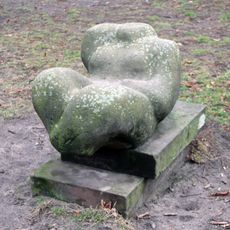
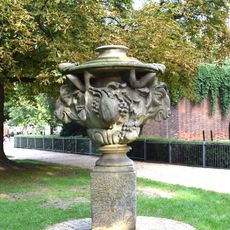
During the 1999/2000 restoration, divers found 20 well-preserved stone blocks in the silt beneath the Spree, among them parts of the stone putti and obelisks and a large shell-limestone base. The pieces were restored or reworked in a stonemason's workshop in Spandau. Since that work ended, the bridge has been closed to normal road traffic.
The community of curious travelers
AroundUs brings together thousands of curated places, local tips, and hidden gems, enriched daily by 93,999 contributors worldwide.