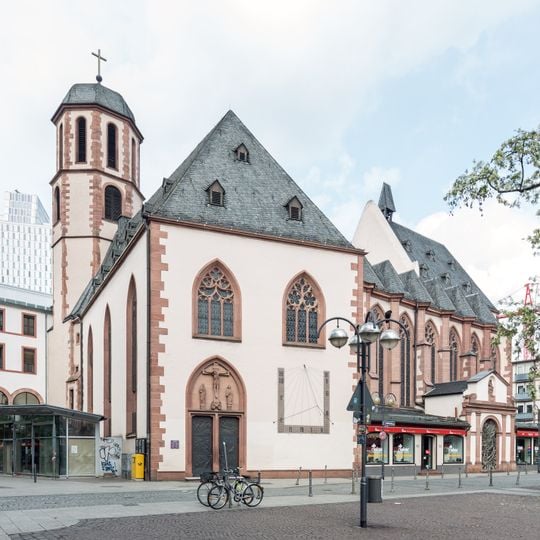
Liebfrauen, Frankfurt, Gothic church in Altstadt, Frankfurt, Germany
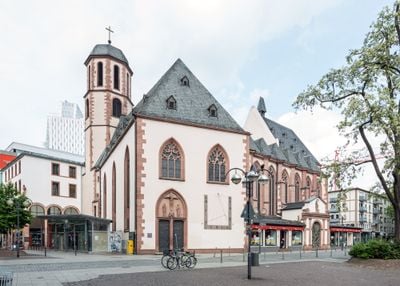
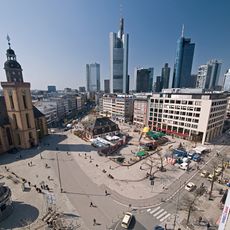
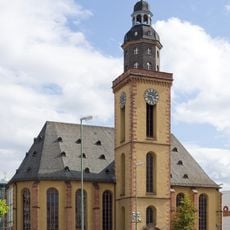
Liebfrauenkirche is a Gothic church on the Liebfrauenberg in Frankfurt's northern Altstadt, built in phases from the 14th to the 16th century. Its pale plastered facade carries red-brown stone trim, a square tower with a grey hipped roof and cross, and a steep slate roof with small dormers. Two large traceried windows sit above a pointed portal with sculpted figures and twin dark doors; a square sundial is set to the right of the portal. The interior, rebuilt in 1955/1956, has wooden ceilings in place of the lost Gothic vaults.
A family chapel founded by the patrician Wigel von Wanebach and his son-in-law Wigel Frosch was raised in 1325 by Archbishop Matthias von Buchegg of Mainz to a collegiate church, Frankfurt's third. In 1344 it was enlarged into a three-aisled Gothic hall church; from 1415 the south facade received a tympanum of the Adoration of the Magi from Madern Gerthener's workshop, and in 1453 a tower of the 12th-century city wall became its bell tower. Jörg Östereicher lengthened the nave and enlarged the choir in 1506–1509.
The name Liebfrauen means "Our Lady", referring to Mary. Since 1923 Capuchin friars have served here, and they offer breakfast to homeless people. The church is open daily from 6 am to around 10 pm, with three masses a day, lauds, a ten-minute noon prayer with music, and vespers.
The church opens early in the morning and stays accessible throughout the day, allowing visitors time to explore the interior at their own pace. Wear respectful clothing and plan your visit around regular services, as some areas may be restricted during worship times.
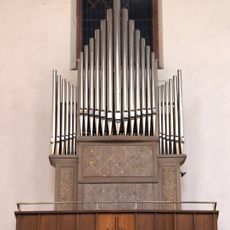
Inside the church sits a modern organ built by Karl Göckel in 2008 that blends German and French Romantic traditions. This instrument shows how historic spaces continue to welcome contemporary musical culture.
The community of curious travelers
AroundUs brings together thousands of curated places, local tips, and hidden gems, enriched daily by 93,100 contributors worldwide.