Fraubillen cross, Ancient menhir cross in Ferschweiler Plateau, Germany
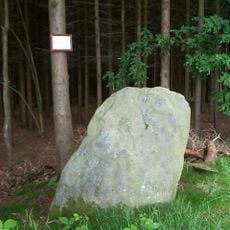
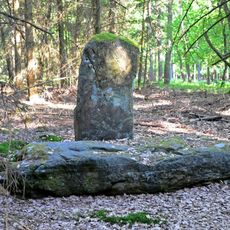
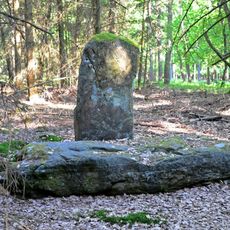
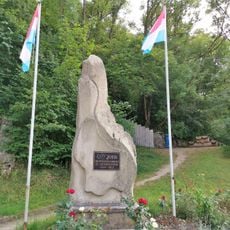
The Fraubillen cross is a menhir on the Ferschweiler Plateau in the Eifel, now about 3.3 to 3.5 metres high; it was originally 4 to 5 metres tall. Two figure niches surrounded by holes are cut into its Lias sandstone, and the stone was reworked into a cross shape.
The menhir was erected around 3000 BC, making it roughly 5,000 years old, and was originally between 4 and 5 metres tall. According to tradition, the missionary Willibrord chiselled the Lias sandstone block into a cross by hand, Christianising it; it now stands about 3.3 to 3.5 metres high. It was recorded in 1617 as the Sybillen Creutz.
The name's origin is debated: it may come from "Unserer lieben Frau Bild-Kreuz" (Sculpted Cross of Our Dear Lady), or from Sibyl, a name for prophetic women, since the stone was recorded in 1617 as "Sybillen Creutz". Church historian Rainer Neu reads it from Dutch and Rhenish dialect, where "Billen" means buttocks, making it a "woman-buttocks cross". Nusbaum took the menhir into its municipal coat of arms.
The cross stands on an open plateau in the hilly Eifel region and is easily reachable from several nearby villages. The site offers little shelter or shade, so sturdy footwear and weather-appropriate clothing are advisable for your visit.
The name may come from "Unserer lieben Frau Bild-Kreuz", but church historian Rainer Neu reads it in Dutch and Rhenish dialect, where "Billen" means buttocks: Fraubillenkreuz, a "woman-buttocks cross". The 1617 form Sybillen Creutz supports the rival derivation from Sibyl, a name for prophetic women.
The community of curious travelers
AroundUs brings together thousands of curated places, local tips, and hidden gems, enriched daily by 94,928 contributors worldwide.