Friedhof II der Sophiengemeinde Berlin, Cultural heritage cemetery in Berlin-Mitte, Germany.
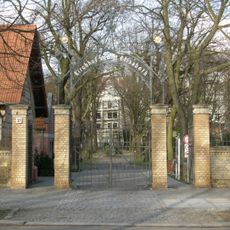
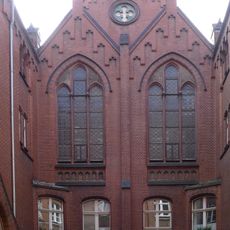
Friedhof II der Sophiengemeinde is a Protestant cemetery of the Sophienkirche at Bergstraße 29 in Berlin-Mitte, laid out as an Alleequartierfriedhof covering 64,621 m² between Bergstraße, Bernauer Straße, Ackerstraße and Invalidenstraße. Its chapel was built around 1898, with a mosaic over the entrance portal made by the firm Puhl & Wagner. Wall graves line the main entrance, six mausoleums stand in the middle, and the Lazarus hospital deaconesses' burial ground lies at the rear.
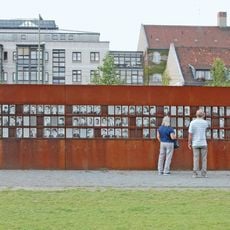
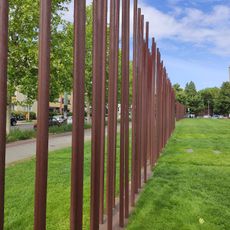
The Sophiengemeinde opened its first churchyard by the Sophienkirche in 1713 and a second one before the Hamburger Tor in 1798. When that site on Gartenstraße was sold, levelled and deconsecrated, the parish used the proceeds to buy the larger plot at Bergstraße, keeping the name II. Sophien-Friedhof. The cemetery was extended and redesigned in 1852 to a plan by Rudolph Schröder, and in 1865 a sightline was cut toward the new Lazarus hospital. From 1961 a 50-metre strip along Bernauer Straße was deconsecrated for the Berlin Wall installations.
The cemetery belongs to the Protestant Sophienkirche; its name refers to the parish, not to a saint's shrine. The six mausoleums in the centre form a single ensemble, and the Lazarus hospital deaconesses have their own burial ground at the rear. The chapel mosaic above the portal was made by the firm Puhl & Wagner around 1898.
The main entrance is at Bergstraße 29; the grounds lie in the block between Bergstraße, Bernauer Straße, Ackerstraße and Invalidenstraße. The chapel with its Puhl & Wagner mosaic stands near the entrance, the six mausolea in the middle, the Lazarus deaconesses' burial ground at the rear. A 50-metre strip along Bernauer Straße was deconsecrated during the 1960s for the border installations and is now part of the Berlin Wall memorial's open-air museum.
The cemetery holds 340 individual graves and 287 people in a collective grave for victims of war and tyranny, a memorial section often passed unnoticed. Along the Bernauer Straße edge, a 50-metre strip was deconsecrated in the 1960s for the Wall's border installations; it remains part of the Berlin Wall open-air museum.
The community of curious travelers
AroundUs brings together thousands of curated places, local tips, and hidden gems, enriched daily by 94,637 contributors worldwide.