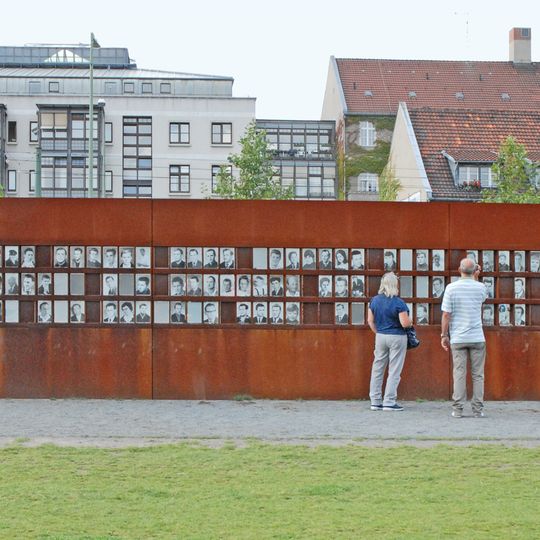
Gedenkstätte Berliner Mauer, Memorial site in central Berlin, Germany.
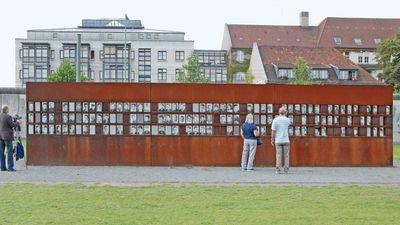
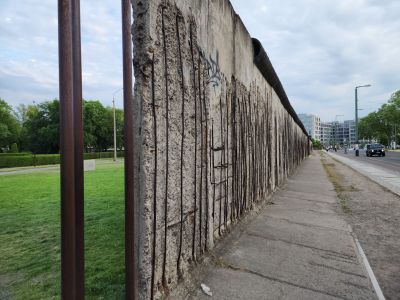
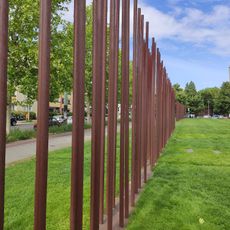
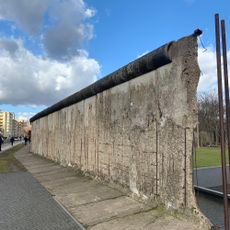
The Berlin Wall Memorial stretches over 1.4 kilometers of former border strip, featuring preserved sections of the original wall and border fortifications.
The memorial marks the location where East and West Berlin were physically separated from 1961 to 1989, leading to numerous escape attempts.
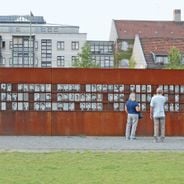
The Documentation Center presents exhibitions, photographs, and personal accounts that detail the impact of German division on Berlin residents.
Visitors can access the open-air exhibition daily from 8:00 to 22:00, while the Documentation Centre operates Tuesday through Sunday between 10:00 and 18:00.
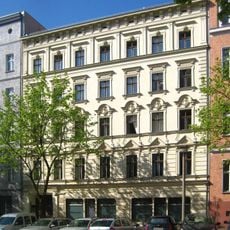
The site includes the excavated foundations of apartment buildings whose facades became part of the border wall during the separation period.
Location: Berlin
Accessibility: Accessible en fauteuil roulant
Operator: Stiftung Berliner Mauer
Address: Bernauer Str. 111, 13355 Berlin, Germany
Website: https://berliner-mauer-gedenkstaette.de/fr
GPS coordinates: 52.53457,13.38944
Latest update: May 12, 2025 11:54
Berlin presents a different side away from the usual landmarks. This selection features lesser-known places where history blends with modern creativity. The former Tempelhof Airport transformed into a public park, Teufelsberg built on war debris with its old American listening station, or the Boros Collection housed in a Second World War bunker, reflect the city's turbulent past. The Spreepark, an abandoned amusement park from the GDR era, and the Monster Cabinet with its mechanical installations offer unusual experiences. These sites tell Berlin in a different way. From the Spy Museum detailing espionage during the Cold War to Badeschiff, a swimming pool built on the Spree, to the radio tower Funkturm with views of the German capital, each location has its unique character. Local markets, underground galleries, and stands like Curry 36, a Berlin institution since 1980, complete this exploration of a city with many faces, where each neighborhood retains its own features.
Berlin has reinvented itself several times in its history, and these transformations remain visible across the city today. You can see Prussian palaces like Charlottenburg, the large dome of the parliament building, the Brandenburg Gate, and the museums on Museum Island, where ancient art from different periods is displayed. The memorial church stands next to modern shopping streets, and the television tower at Alexanderplatz marks the skyline above the city center. More recent history shapes the city just as strongly. The Berlin Wall Memorial on Bernauer Strasse recalls the division, while the East Side Gallery along the river shows a painted stretch of the wall. The Holocaust Memorial, the Topography of Terror, and the Stasi Museum document the darkest chapters of the 20th century. The GDR Museum and the Palace of Tears offer a glimpse into daily life in the divided city. Between these serious places you find Tiergarten park, the zoo, and squares like Gendarmenmarkt, where you can simply sit and watch modern Berlin go by.
More than thirty years after its fall, the Berlin Wall still shapes the city. Between the districts of Mitte, Prenzlauer Berg, and Friedrichshain, fragments of concrete, watchtowers, and memorial plaques recall the division of a capital and its people. Some sections remain intact, others have been turned into memorials or works of art, like the East Side Gallery. Along the old border lines, museums and parks bring these historical traces back to life: Checkpoint Charlie, Bernauer Straße, the Topography of Terror, and Mauerpark. Each site holds a particular stillness, reflecting a time that Berlin does not erase but keeps present in memory. These places invite visitors to understand, to feel, and sometimes simply to remember. At Bernauer Straße, the central memorial preserves original Wall sections alongside a documentation center. The East Side Gallery displays murals by artists from around the world along more than a kilometer of Wall. The border crossing at Bornholmer Straße was the first to open on November 9, 1989. Mauerpark, once a stretch of death strip and border zone, now fills with people gathering to celebrate and relax. Smaller traces like the former watchtower at Schlesischer Busch or the Wall fragment on Liesenstraße sit quietly among residential buildings, reminding passersby that the border once ran straight through daily life.
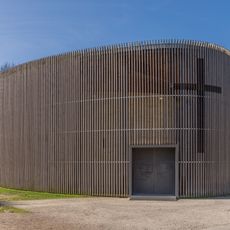
Kapelle der Versöhnung
221 m
Factory Berlin
444 m
Elisabethkirche
552 m
Friedhof II der Sophiengemeinde Berlin
170 m
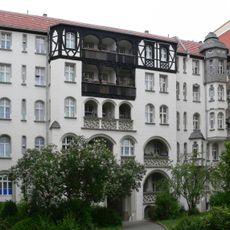
Ernst-Reuter-Siedlung
280 m
St. Sebastian, Berlin
542 m
Ernst-Reuter-Oberschule
528 m
Musikgymnasium Carl Philipp Emanuel Bach
463 m
Markthalle VI (Berlin)
584 m
Park am Nordbahnhof
371 m
St. Elisabeth-Friedhof
259 m
Lazarus-Krankenhaus Berlin-Gesundbrunnen
78 m
Nordbahnhof Carré
334 m
Erlöserkirche
556 m
Pappelplatz
451 m
Edison-Höfe
536 m
Stettiner Carré
436 m
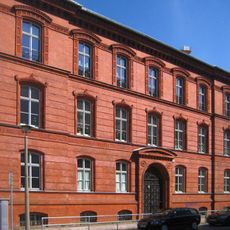
Dokumentationszentrum Berliner Mauer
96 m
Postamt N 4
462 m
Residential building Rheinsberger 73
508 m
Strelitzer Straße 61
360 m
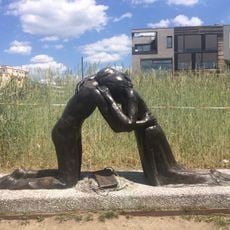
Reconciliation
231 m
Schrippe
111 m
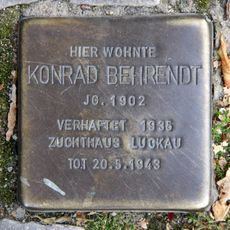
Stolperstein dedicated to Konrad Behrendt
287 m
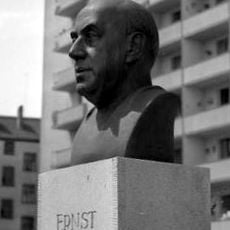
Ernst-Reuter-Büste
294 m
Evangelisches Werk für Diakonie und Entwicklung, Bibliothek, Bestand Berlin
429 m
Deutsche Höfe
316 m
Mount Mitte
347 mReviews
Visited this place? Tap the stars to rate it and share your experience / photos with the community! Try now! You can cancel it anytime.
Discover hidden gems everywhere you go!
From secret cafés to breathtaking viewpoints, skip the crowded tourist spots and find places that match your style. Our app makes it easy with voice search, smart filtering, route optimization, and insider tips from travelers worldwide. Download now for the complete mobile experience.
A unique approach to discovering new places❞
— Le Figaro
All the places worth exploring❞
— France Info
A tailor-made excursion in just a few clicks❞
— 20 Minutes