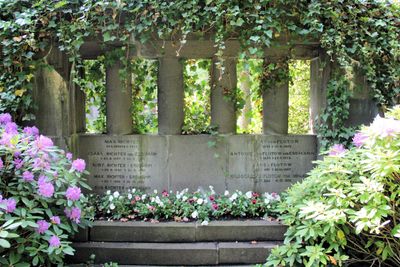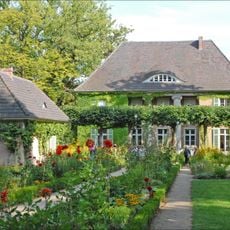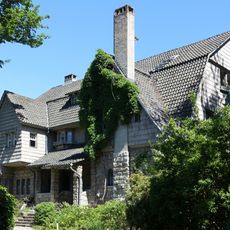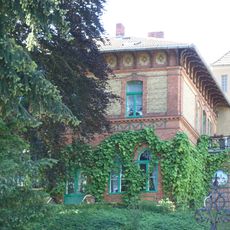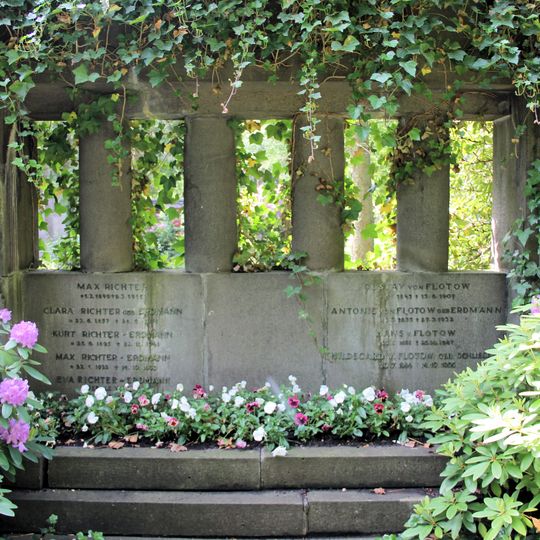
Friedhof Wannsee, Lindenstraße, Cemetery and cultural heritage monument in Steglitz-Zehlendorf, Germany.
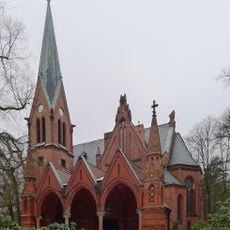
Friedhof Wannsee, Lindenstraße is a cemetery at Lindenstraße 1/2 in Berlin-Wannsee, founded in 1886 for the Alsen colony and also called Neuer Friedhof Wannsee or Friedhof Wannsee II. Its chapel was built by architect Otto Stahn, who is buried here. The cemetery was enlarged in 1918 by about 9,000 square metres after the western wall was opened.
The cemetery was laid out in 1886 for the residents of the Alsen colony, founded by banker Wilhelm Conrad, a member of the Club of Berlin. Conrad and Oscar Huldschinsky ensured it was open to all faiths, since many club members were baptized Jews with unbaptized relatives. In 1918 the western perimeter wall was breached and the cemetery enlarged by about 9,000 m².
The cemetery's name distinguishes it from the Old Wannsee Cemetery on Friedenstraße, so it is also called Neuer Friedhof Wannsee or Friedhof Wannsee II. On the cemetery wall, a small symbol combining a Christian cross with a Star of David recalls that it was established for all faiths, because many Berlin Club members were baptized Jews with unbaptized relatives.
The cemetery is at Lindenstraße 1/2 in Wannsee, with the entrance on Lindenstraße. The grounds are level and paths run between the graves; the war graves line one wall and a monument stands beside the chapel. The western wall was opened in 1918 when the cemetery was enlarged by about 9,000 square metres.
Several Nobel Prize winners are buried here, among them the chemist Emil Fischer, whose grave stands alongside those of Berlin merchants and scientists from the same era. Their resting places are often easy to miss if you are not looking for them.
The community of curious travelers
AroundUs brings together thousands of curated places, local tips, and hidden gems, enriched daily by 93,998 contributors worldwide.