Wilmersdorf Cemetery, Garden monument cemetery in Charlottenburg-Wilmersdorf, Germany.
Wilmersdorf Cemetery is a state-owned avenue cemetery of 10.12 hectares in Berlin-Wilmersdorf, laid out from 1885/1886 with a right-angled path grid and avenues of linden and plane trees. Its chapel, built to designs by Max Contag and Christian Havestadt, was destroyed in the Second World War and later removed; the path rondel remains, planted with rhododendrons. Sections A, B and D are a registered garden monument.
The cemetery was laid out in 1885/1886 as the municipal cemetery of the rural community of Deutsch-Wilmersdorf, west of the village centre and south of Berliner Straße, on about one hectare. By 1887 a brick chapel with an attached mortuary, designed by Max Contag and Christian Havestadt, stood at its centre, and the grounds were opened up by a right-angled path grid whose main walks were planted as avenues, mainly with limes and planes. Between 1906 and 1915 the cemetery was extended south, west and east, largely keeping the same design principles, with plans attributed to Richard Thieme. The chapel was badly damaged in the Second World War and afterwards demolished; its site is now planted with rhododendrons.
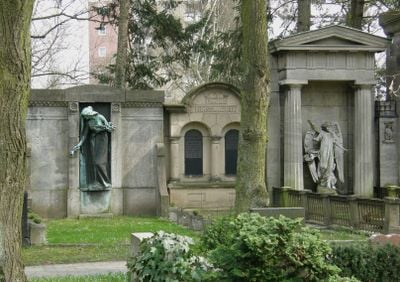
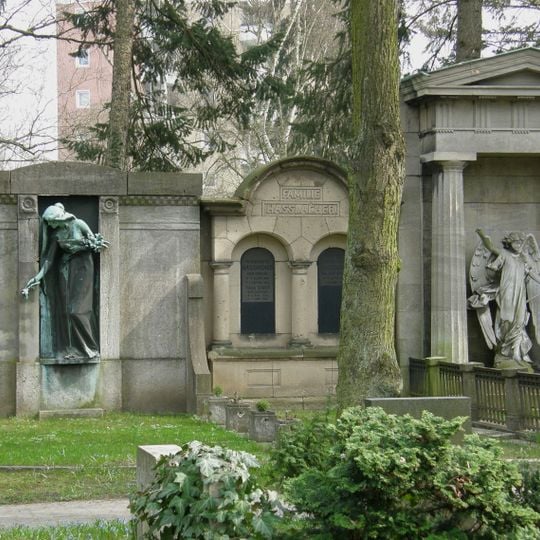
The cemetery's name comes from the former Landgemeinde Deutsch-Wilmersdorf, whose municipal cemetery it was from 1885/1886. The main paths were laid out as avenues, mostly planted with linden and plane trees, and the perimeter wall carries numerous monumental family burial plots. The surviving wall monuments, such as the aedicule inscribed "FAMILIE HASS LACHER", show how Wilmersdorf families commemorated their dead.
The cemetery is reached from Berliner Straße, where the former main entrance now serves as a side entrance. The straight main paths are laid out as avenues, mainly planted with linden and plane trees, and the surviving wall graves and mausoleums line the outer walls. The chapel that once stood at the centre was demolished after war damage; its circular path junction remains, planted with rhododendrons.
The cemetery's layout follows a right-angled grid of paths, with the main routes planted as avenues of lindens and plane trees. The design for the southern, western and eastern extensions between 1906 and 1915 is attributed to Richard Thieme. The chapel by Max Contag and Christian Havestadt, built by 1887 in brick, was badly damaged in the Second World War and later demolished; its circular path survives, planted with rhododendrons.
The community of curious travelers
AroundUs brings together thousands of curated places, local tips, and hidden gems, enriched daily by 94,458 contributors worldwide.