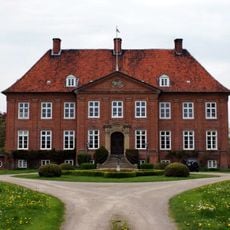
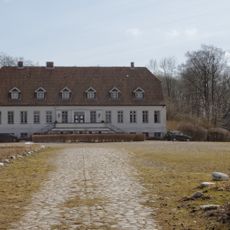
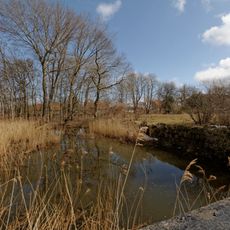
Herrenhaus Karlsburg, Manor house in Winnemark, Germany
Herrenhaus Karlsburg is a country manor in Winnemark, Schleswig-Holstein, whose core dates from the 1720s. Its present form results from a rebuild begun in 1822: a broad twelve-axis block with a tower-like central riser, once topped until 1853 by a lantern. Two southern wings were demolished in the 19th century; a Régence festival hall survives upstairs.
The estate grew out of the village of Gereby, first mentioned in 1335 and owned by the Rantzau family from 1539, who cleared the village for a fortified manor farm. In 1826 it was renamed Carlsburg after its new owner, Prince Karl of Hesse-Kassel, who had abolished serfdom here in 1790. The house passed to the ducal house of Schleswig-Holstein-Sonderburg-Glücksburg in the 19th century.
The estate's name changed from Gereby to Carlsburg in 1826, after Prince Karl of Hesse-Kassel, who had resided at Gottorf Castle in Schleswig. The renaming followed his abolition of serfdom on Gereby in 1790 and the parcelling and leasing of the lands. The manor later passed by inheritance to the ducal house of Schleswig-Holstein-Sonderburg-Glücksburg.
Schloss and park are private and not open to the public; the house can only be viewed to a limited extent from outside. Access is via the Karlsburger Allee, a roughly 650 m private drive from Köllnerfeld lined with very old trees, so visitors should stay on public paths. The estate lies in the municipality of Winnemark, Amt Schwansen, near the Schlei.
The estate was renamed Carlsburg in 1826 after its new owner, not in 1807; the village itself had been called Gereby since 1335. The ducal family planned in 1876 to add two north wings and two stair towers, but the plans were never carried out.
The community of curious travelers
AroundUs brings together thousands of curated places, local tips, and hidden gems, enriched daily by 93,956 contributors worldwide.