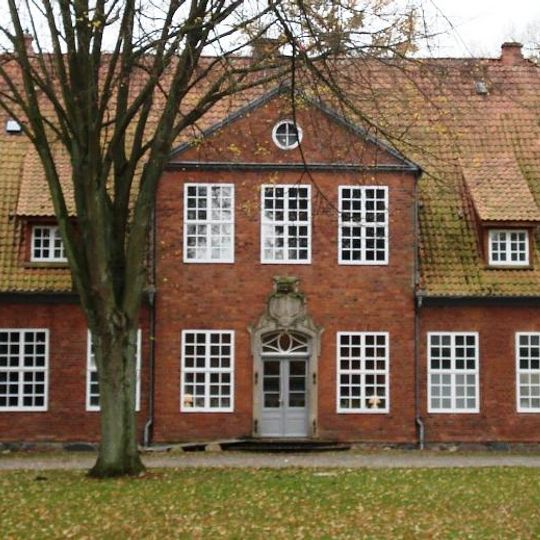
Herrenhaus Stockelsdorf, Cultural heritage manor in Stockelsdorf, Germany.
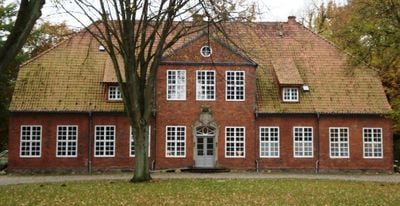
Herrenhaus Stockelsdorf is a single-storey manor house of unplastered red brick on a fieldstone foundation, measuring about 30 by 20 metres. A central risalit about a quarter of the facade's width carries a triangular gable with a round window, and the portal is framed in sandstone with the builder's coats of arms and the date 1761.
Georg Nicolaus Lübbers bought the Stockelsdorf estate and had the manor built in 1761, probably by architect Johann Adam Soherr, after an earlier manor house was demolished. In 1771 Lübbers founded the Stockelsdorf faience manufactory. Through his daughter Maria Catharina, who married the later Lübeck mayor Friedrich Nölting, the estate passed to the Nölting family after Lübbers's death.
The building has served the community since 1950, when the municipality bought the manor and its land and used it as a school. Since 2000 it has belonged to the non-profit Stiftung Herrenhaus Stockelsdorf, founded that October and approved on 13 December 2000, which runs it for concerts, exhibitions and a restaurant.
The manor stands at the centre of Stockelsdorf, about 2 km from Stockelsdorf station and roughly 15 km from Lübeck airport, reachable by bus, car or bicycle. The building is used for concerts, exhibitions and a restaurant, so check current opening times and event dates before setting out. Part of the former estate garden survives as a public park next to the house.
The sandstone frame around the main portal, crowned with the builder's coats of arms and the date 1761, is the only Rococo element on an otherwise plain brick facade. The roof was probably once a divided Baroque roof, unlike today's red-tiled Krüppelwalmdach with its two dormers.
The community of curious travelers
AroundUs brings together thousands of curated places, local tips, and hidden gems, enriched daily by 93,764 contributors worldwide.