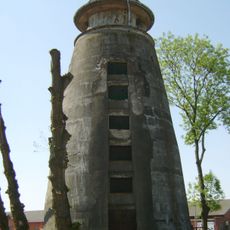
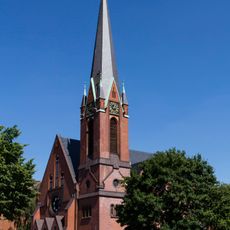
Vorwerker Friedhof, Cemetery and park in Lübeck, Germany
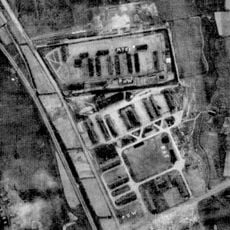
Vorwerker Friedhof is Lübeck's largest cemetery, covering 53 hectares with almost 50,000 burial plots. It is laid out as an oval garden cemetery, bordered by Friedhofsallee and the Fackenburger Landgraben, and includes war grave sections for several nations from both World Wars.
In 1902 Lübeck's citizens' committee rejected a new cemetery at Schönböckener Straße, and the Senate then proposed a 21-hectare state-owned site between Krempelsdorf and Vorwerk. The city acquired the cemetery on 17 September 1906; Erwin Barth designed it as a garden cemetery, and the first burial took place on 13 May 1907. Chapel 1 followed in 1908–1909 to plans by Carl Mühlenpfordt.
The cemetery holds war grave sections for several nations from both world wars, including a memorial to Estonians who died in Lübeck. The Jewish cemetery adjoins it at pedestrian entrance 4, and the grounds are served by tram line 7. Two bells hang in the chapels: an iron cast-steel bell cast in 1949 by J. F. Weule in Bockenem for Chapel 1, and a smaller bell cast in 1959 by Petit & Gebr. Edelbrock in Gescher for Chapel 2.
The cemetery is accessible on foot with broad paths that wind through the park and connect different areas. Visitors should wear comfortable shoes since the grounds are large and it takes time to explore the various sections.
The crematorium at the far end, by the Landgraben border, was built as a cremation church with a portico; it was the first of its kind in what is now Schleswig-Holstein, predating Kiel's, approved only in 1912 and operating from 1916. Architect Carl Mühlenpfordt gave it a tall granite base and steep roof.
The community of curious travelers
AroundUs brings together thousands of curated places, local tips, and hidden gems, enriched daily by 94,540 contributors worldwide.