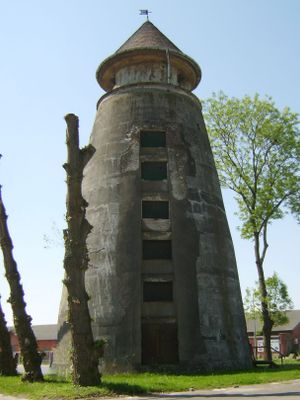
Bunker Einsiedelstraße, World War II air raid shelter in St. Lorenz Nord, Lübeck, Germany.
Bunker Einsiedelstraße is a conical concrete tower with nine floors, marked by a distinctive narrowing between its main body and roof peak. The structure features steeply sloping walls designed by Leo Winkel's patent method and includes an observation post at its top.
Built in 1940 on the grounds of the Lübeck Machinery Company, the bunker was designed to protect 500 workers during air raids. After the war, rectangular openings were cut into its walls as part of demilitarization.
The bunker displays its shingle-covered roof as a blend of wartime engineering and regional building traditions. This mix of practical defense and local architectural style shapes how it appears in the city.
The steeply sloping walls were designed to deflect incoming bombs and protect the structure from impact. From Lübeck's old town, the building is clearly visible and dominates the industrial area of St. Lorenz Nord.
The rectangular openings cut after the war remain visible as marks of the building's disarmament. This detail shows how the structure carries its wartime past as a visible reminder in its walls.
The community of curious travelers
AroundUs brings together thousands of curated places, local tips, and hidden gems, enriched daily by 92,586 contributors worldwide.