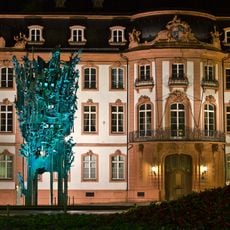
Schönborner Hof, Baroque mansion in city center, Mainz, Germany.
Schönborner Hof is a nobleman's residence built between 1668 and 1670 at the north-western end of what was then the Thiermarkt, today's Schillerplatz. It is regarded as the first noble court in Mainz built in the new Baroque style, despite facade similarities to the late-Renaissance Haus Römischer Kaiser. The main building, designed by the Mainz master builder Clemens Hinck, originally had only one upper storey with a side risalit and Renaissance stepped gables; the 19th-century extra storey was removed after severe damage in the Second World War, restoring the 17th-century state.
Philipp Erwein von Schönborn, privy councillor of Mainz and younger brother of Elector Johann Philipp von Schönborn, commissioned the court, built between 1668 and 1670 at the north-western end of the Thiermarkt. The Mainz master builder Clemens Hinck designed the main building, probably advised by Edmund Rokoch. It counts as the first noble court in Mainz built in the Baroque style. In 1798 it became a barracks and hospital under French rule, and in the 19th century an officers' mess, raised by one storey and stripped of its gables.
Since 1946 the mansion has housed a French studies centre, later the Maison de France and today the Institut français, founded with Raymond Schmittlein's support. Its mediathek holds over 12,000 French-language media, and since 1994 the CinéMayence cinema, run by AG Stadtkino, uses a hall that served as the institute's film room in the 1950s.
The Institut français occupies the Schönborner Hof, with its mediatable of over 12,000 French-language items open to visitors; the CinéMayence cinema, run by AG Stadtkino e.V., uses a hall that served as the institute's film room in the 1950s. The University of Mainz's prehistory institute and its library also use parts of the building, while the Landeshochschulkasse sits in the Wichernhaus. The Schoppenstecher statue stands in the green space between the courtyard and the Proviantamt.
Excavations in 2002 uncovered an original baroque fountain in what was once the garden area behind the mansion. This discovery revealed that water features were an important part of the property's original design, now lost to later developments.
The community of curious travelers
AroundUs brings together thousands of curated places, local tips, and hidden gems, enriched daily by 93,099 contributors worldwide.