Friedenskirche, Church building in St. Johannis, Nuremberg, Germany
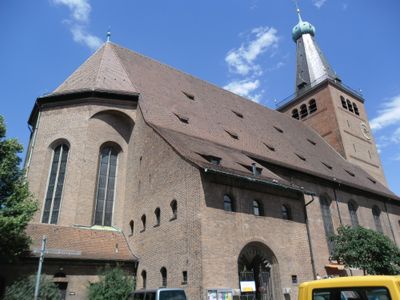
Friedenskirche stands at Palmplatz 11 in St. Johannis, built 1925–1928 to German Bestelmeyer's design as an Evangelical Lutheran memorial church for the city. Its entrance portal borrows Romanesque stylistic forms, and the broad hall interior holds furnishings from the Heilig-Kreuz-Pilgerspital church destroyed in the war. The choir altar comes from Michael Wolgemut's workshop, and the three choir windows have coloured glazing designed by Adolf Schinnerer in 1928.
Plans for the church began in 1916, when it was conceived as a memorial and warning for the whole city. Built 1925–1928 to a design by German Bestelmeyer, it burned out in 1944 after a bombing raid and was rebuilt from 1950 to 1952. Its entrance portal reuses forms of Romanesque church architecture.
The name Friedenskirche, planned from 1916 as a memorial and warning for the whole city, refers to peace. Every Friday at 9 a.m. the Friedensglocke, Bavaria's heaviest Protestant church bell, strikes the full hour in memory of Jesus' crucifixion; it has its own hammer for this. The ringing comes from eleven bells in a steel frame, about 20.5 tonnes in all.
The church stands at Palmplatz 11 in St. Johannis. The entrance portal uses forms of Romanesque church architecture, and the choir windows hold coloured glazing designed by Adolf Schinnerer in 1928. The organ, built by Steinmeyer in 1956, has 48 stops on three manuals and pedal.
The heaviest bell in the ring, the Friedensglocke, is the heaviest Protestant church bell in Bavaria; the eleven bells together weigh about 20.5 tonnes. Every Friday at 9 a.m. it also strikes the full hour, recalling the crucifixion of Jesus, which is why it has its own hammer.
The community of curious travelers
AroundUs brings together thousands of curated places, local tips, and hidden gems, enriched daily by 93,013 contributors worldwide.