Gebsattelbrücke, Arch bridge in Au district, Munich, Germany
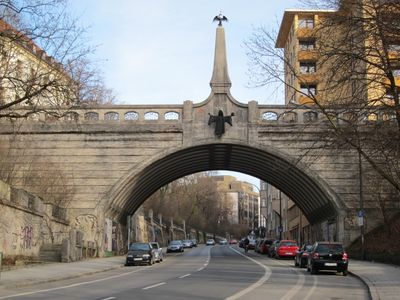
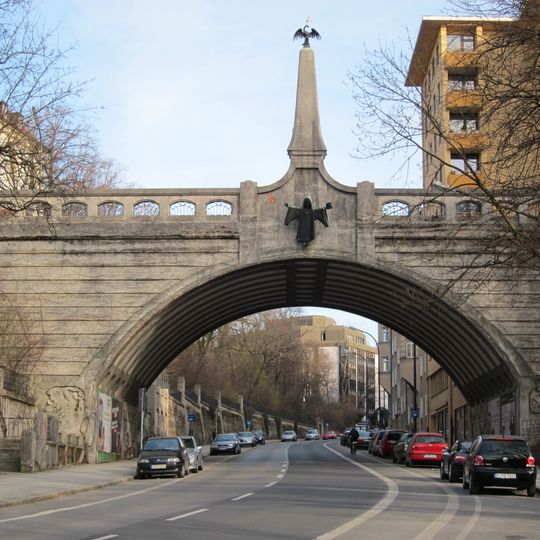
The Gebsattelbrücke is an 18-metre-long, 13.4-metre-wide arch bridge in Munich's Au district. It carries the Hochstraße at right angles over the Gebsattelberg and Gebsattelstraße, a street climbing from Mariahilfplatz to Regerplatz. Its railings have small windows with wrought-iron grilles, and an obelisk topped by a bronze heron holding a lily branch stands at the centre of each side.
Architect Theodor Fischer designed the bridge in 1901 as part of Munich's infrastructure expansion in the growing Au district. Once completed, it provided an essential connection allowing traffic to cross the terrain.
The bridge's railings carry small windows with wrought-iron grilles, and on each parapet stands an obelisk topped by a bronze heron holding a lily branch, the motif of the Au coat of arms. Below each obelisk is a Münchener Kindl sculpture. From 1948 the Munich soapbox derby ran beneath the bridge on the Gebsattelberg, revived in 2004 for the 150th anniversary of the Au's incorporation.
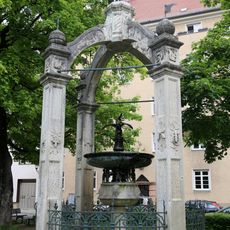
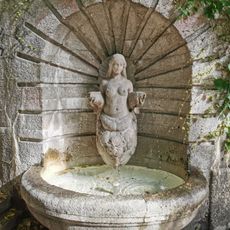
Pedestrians reach the bridge directly from Gebsattelstraße via two stairways, one on the west slope and one on the east; the west stair is adorned with a small fountain by August Blössner (1908), carved by stonemason Philipp Widmer, while the east stair is crowned by an over-life-size bear sculpture. The bridge itself carries the Hochstraße between Nockherberg and Rosenheimer Straße, crossing the Gebsattelberg and Gebsattelstraße at right angles.
The bridge crosses a deep cutting made for Gebsattelstraße, which climbs the Gebsattelberg at right angles to the slope so that the Hochstraße could continue uninterrupted along the ridge. From 1948 the annual Munich soapbox derby was held on the Gebsattelberg beneath the bridge, until the early 1960s; it was revived in 2004 for the "150 Jahre Eingemeindung Au" festival.
The community of curious travelers
AroundUs brings together thousands of curated places, local tips, and hidden gems, enriched daily by 94,640 contributors worldwide.