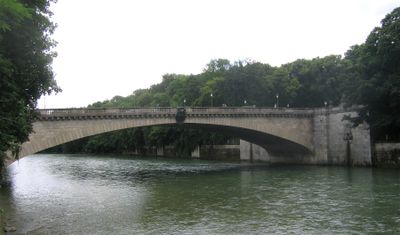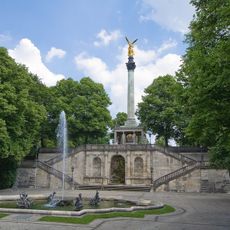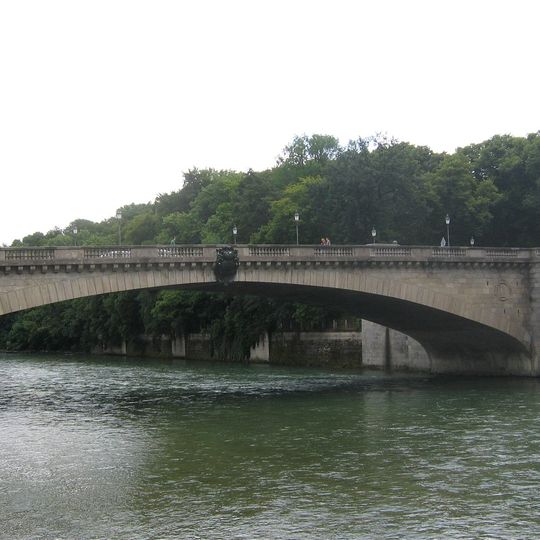
Luitpoldbrücke, Stone arch bridge in Bogenhausen district, Munich, Germany.
Luitpoldbrücke is a stone arch bridge crossing the Isar River in Munich, built from limestone with three flat arches and ornate architectural detailing. The crossing links the Altstadt-Lehel and Bogenhausen districts with separate paths for vehicles and pedestrians on each side.
An earlier wooden structure from the 19th century was destroyed during a major flood in 1899, prompting architect Theodor Fischer to design this stone replacement. The current structure opened in 1901 and became a central landmark for crossing the Isar in Munich.
Stone sculptures at the four corners of the bridge represent Bavarian regions: a hunter for Old Bavaria, a woman with fruit for Swabia, a fisherman for Franconia, and a grape bearer for the Palatinate. These figures tell the story of the different areas this bridge connects.
The bridge is easy to cross on foot or by car, with clear separation between traffic directions and wide walkways on each side. The access is level and barrier-free, making it suitable for all types of visitors throughout the day.
The main central arch spans about 62 meters with a notably flat curve, which was an engineering achievement for the early 1900s. This wide span combined with a low profile made the structure stand out as an innovative design for its time.
The community of curious travelers
AroundUs brings together thousands of curated places, local tips, and hidden gems, enriched daily by 92,419 contributors worldwide.