Gamrig, Mountain summit in Sächsische Schweiz-Osterzgebirge, Germany
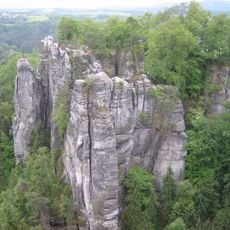
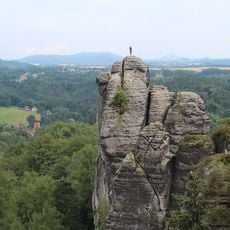
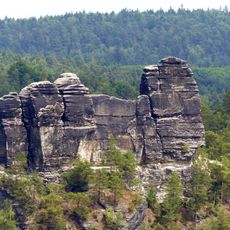
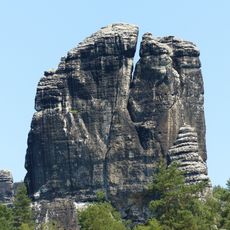
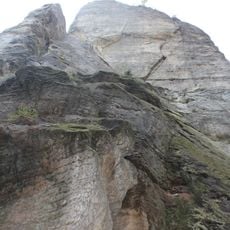
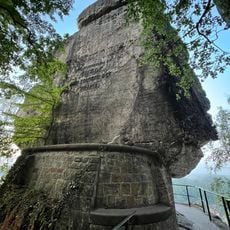
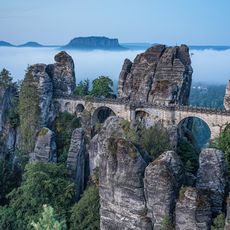
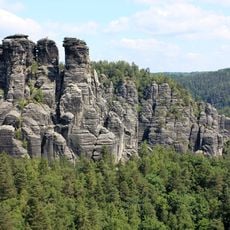
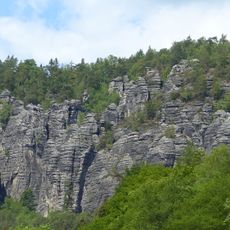
Gamrig is a 253-metre sandstone rock group east of Rathen, rising 20–40 metres above the Waltersdorf plateau. It is the remnant of a once-continuous sandstone table that also included the Carolastein, Fritschenstein and Bockstein. Six climbing summits — Gamrigkegel, Gamrigscheibe, Gamrigwächter, Heidebrüderturm, Heidestein and Waltersdorfer Horn — carry over 130 routes. A stepped path climbs the west side to an unrailed summit plateau.
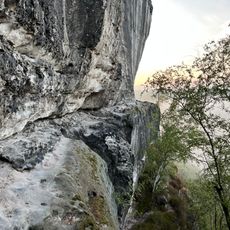
The Gamrig was recorded as Gamigkstein in Matthias Oeder's first Saxon land survey of 1592, and the name Gammerig remained in use into the 20th century. Unlike Falkenstein or Neurathen, it never served as a castle watchtower. In the second half of the 19th century, fine sandstone was quarried from the Gamrighöhle on its southeast side and sold as scouring sand to inns and soap factories.
The name Gamrig derives from the Slavic kamen, meaning stone; early maps record it as Gamigkstein, and Gammerig remained in use into the 20th century. Caspar David Friedrich climbed it in 1808 and reused the motif in his 1818 painting Wanderer above the Sea of Fog. The summit has also served as a film location, including scenes for Polizeiruf 110 in 1981 and Der Ranger – Paradies Heimat in 2017.
A stepped path on the western side leads to the summit, with parking available in the nearby village of Waltersdorf. The route is clearly marked and accessible for regular hikers.
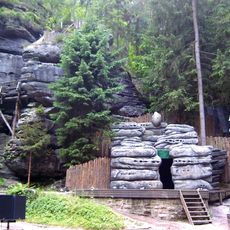
A cave on the southeastern face cuts deep into the rock and reveals marks from historical sand extraction work. Visitors can still spot traces of this past activity in the stone walls today.
The community of curious travelers
AroundUs brings together thousands of curated places, local tips, and hidden gems, enriched daily by 94,225 contributors worldwide.