Schloss Hohenbuchau, Neo-baroque castle in Georgenborn, Germany
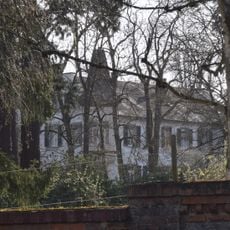
Schloss Hohenbuchau was a castle-like mansion built from 1895 in a park in Georgenborn, replacing an 1869 country estate. The Wiesbaden architect Alfred Schellenberg designed it; the ballroom murals were painted by Max Friedrich Koch. The park held a pond, a Chinese tea house and a Greek temple. The building was demolished in 1963.
In 1863 the Prussian cavalry captain Constantin von Zachau bought 50 acres in Georgenborn and completed a country estate there in 1872; gambling debts forced him to sell it in 1879 to rubber manufacturer Ferdinand Krauskopf. His son, Baron Ferdinand von Krauskopf, had the house demolished and from 1895 built Schloss Hohenbuchau to plans by Wiesbaden architect Alfred Schellenberg. After 1945 the castle decayed, burned on 28 December 1947, and was demolished in 1963 for a housing estate designed by Richard Neutra.
The ballroom murals were painted by Max Friedrich Koch, a Wiesbaden artist. The park once held a Chinese tea house and a Greek temple, built as the dream of a man worth 120 million gold marks. The Chinese pavilion still stands by the perimeter wall.
Very little of the original structure remains visible today, as the site has been altered and new buildings have been constructed. Visitors should research ahead to understand what traces may still be found, since the original estate was largely lost.
The property was temporarily confiscated during World War II and suffered a devastating fire shortly after the war ended. This event accelerated its decline and contributed to its eventual destruction.
The community of curious travelers
AroundUs brings together thousands of curated places, local tips, and hidden gems, enriched daily by 94,044 contributors worldwide.