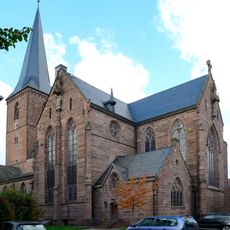
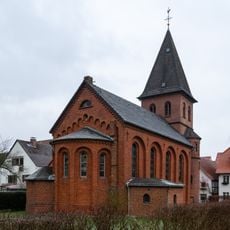
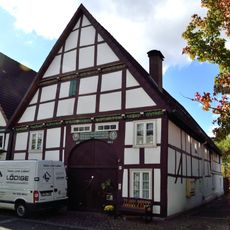
St. Kilian, Romanesque church in Lügde, Germany.
St. Kilian is a Romanesque church in Lügde with a distinctive central tower featuring sound arcades and columns with cube capitals, as well as two transept portals decorated with sculptures. The building sits on a ridge south of town and is surrounded by a cemetery enclosed by high rubble stone walls.
A Carolingian church stood here between 780 and 784; its hall with a recessed choir was excavated beneath the present building. The tower was built around 1100 and raised around 1200, while the nave and choir followed in the last third of the 12th century. Swedish troops damaged the church during the Thirty Years' War, sacking the interior and desecrating graves; a new altar was consecrated once peace returned.
The wall and vault paintings date from around 1200 and follow the Soest school; the apse frescoes are from the early 13th century. The Apostles' frieze was uncovered and completed in 1873, and the paintings were repainted around 1939 and restored between 1971 and 1976. A partial collapse of the apse arch in 1958 destroyed a Majestas Domini, later filled in grisaille in 1961.
The site functions as a cemetery church and can be viewed from the outside, though interior access may be limited. It is best visited in early morning or afternoon light, when the stone details and tower ornamentation are most visible.
On one column capital in the nave, a carved head is known locally as the Neidkopf, the envy head, and is thought to depict the Norse figure Loki. The same capitals carry palmettes, volutes and leaves read as the beginning and end of the world. In the cemetery, a cross before the tower portal commemorates the executioner Mathias Bröcker, who died in 1691.
The community of curious travelers
AroundUs brings together thousands of curated places, local tips, and hidden gems, enriched daily by 92,890 contributors worldwide.