Gerbermühle, Cultural heritage monument in Sachsenhausen, Frankfurt, Germany.
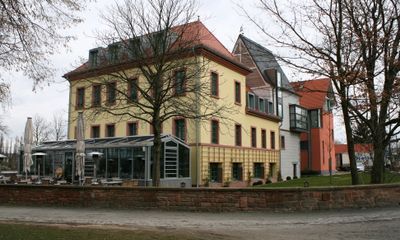
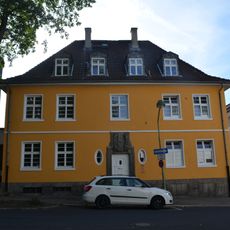
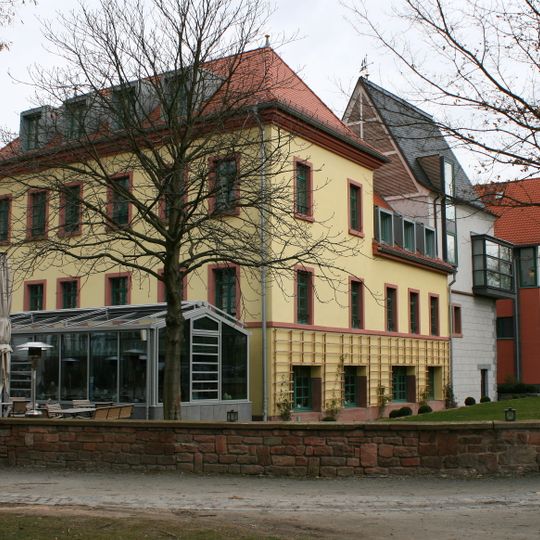
Gerbermühle is a three-story building with a yellow facade, a red hipped roof and a red-brown stone base course, standing in Oberrad on the left bank of the Main opposite the Osthafen. Tall dark-framed rectangular windows form a grid across the front, with a row of smaller square windows on the upper floor; a single-story glass conservatory with a ridged roof extends from the left side of the ground floor. It was built as a water mill, probably around 1520, on the Weschbach.
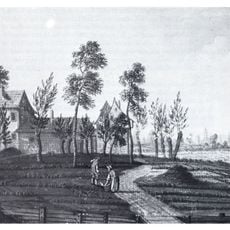
The Wasserhof estate was founded in 1311; the mill itself was probably built around 1520, as bricks from 1519/20 found during renovations suggest. In the 17th century it ground copper paint, and from 1688 to 1723 the tanner Nicolas Coudos from Lorraine leased it, giving it its name. Banker Johann Jakob Willemer converted it into a summer residence in 1785, and since 1803 it has belonged to the city of Frankfurt.
The mill's name comes from the tanner Nicolas Coudos from Lorraine, who leased it from Kunigunde von Holzhausen between 1688 and 1723 and ran his trade there; the name stayed even after the building was converted back into a grain mill. The stone wayside shrine beside the building bears the year 1519, the name Koll and a family coat of arms.
The property has a restaurant area, outdoor terrace, and bar for drinks and local food. The best time to visit is outside peak travel seasons when the spaces are less crowded.
The stone Bildstock beside the building bears the year 1519, the name Koll and a family coat of arms; bricks from 1519/20 found during renovations suggest the mill was built then. Goethe wrote Gingo biloba on 27 September 1815 and sent it to Marianne von Willemer decorated with two ginkgo leaves; the original is now in the Goethe Museum in Düsseldorf.
The community of curious travelers
AroundUs brings together thousands of curated places, local tips, and hidden gems, enriched daily by 92,842 contributors worldwide.