Rauschenburg, Medieval castle ruins in Olfen, Germany
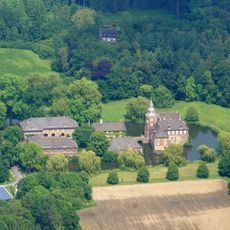
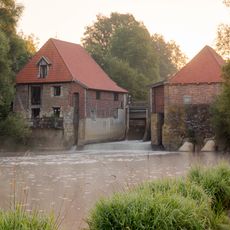
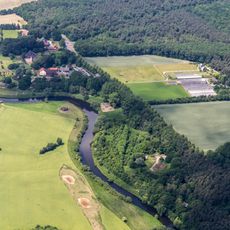
Rauschenburg is a vanished water castle in the Lippe meadows near Olfen. Its three-storey main house with tower resembled Horneburg Castle and stood on an island surrounded by a moat, with a drawbridge linking it to farm buildings and stables outside the ditch. Only foundation remains and cellar vaults survive.
Rauschenburg was first mentioned in 1050. In 1322 the bishops of Cologne and Münster agreed to build a bridge over the Lippe at the castle, a contract renewed in 1444 and 1498. In 1418 Archbishop Dietrich von Moers of Cologne besieged and captured it. The upper storey was demolished in 1878 for a bridge, and the castle remained inhabited until 1900.
The name may come from the rushing sound of former rapids in the Lippe. In 1564, after Ursel von Hörde died childless, Bishop Bernhard von Raesfeld of Münster backed Alard von Hörde and had the castle shelled until Johann von Ascheberg was captured; the two later settled and lived there until 1577. The von Ascheberg line ended in 1638 with the childless death of Heinrich von Ascheberg.
The ruins stand on private property with limited public access, so view them from a distance and respect posted boundaries. The site is reachable on foot from Olfen and offers good vantage points from the surrounding area.
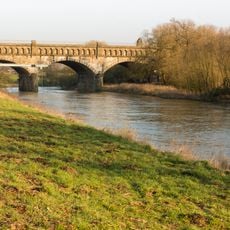
The name may derive from the constant rushing of former rapids in the Lippe at this spot. The castle was built at a ford where horses and carts could cross the river; today the Bundesstraße 235 bridge stands there. In 1878 the upper storey was dismantled and its material reused for a new bridge.
The community of curious travelers
AroundUs brings together thousands of curated places, local tips, and hidden gems, enriched daily by 94,502 contributors worldwide.