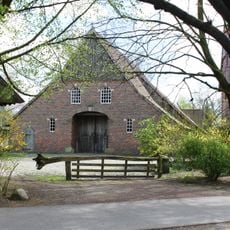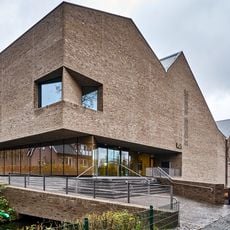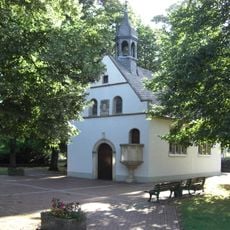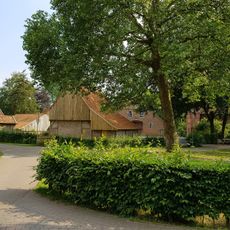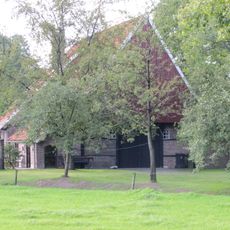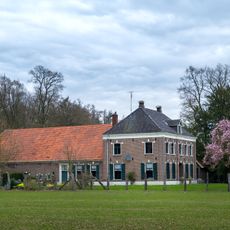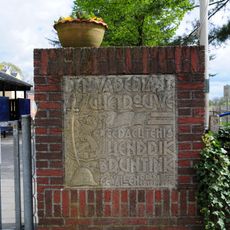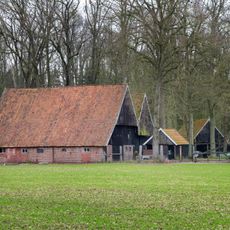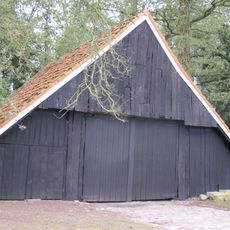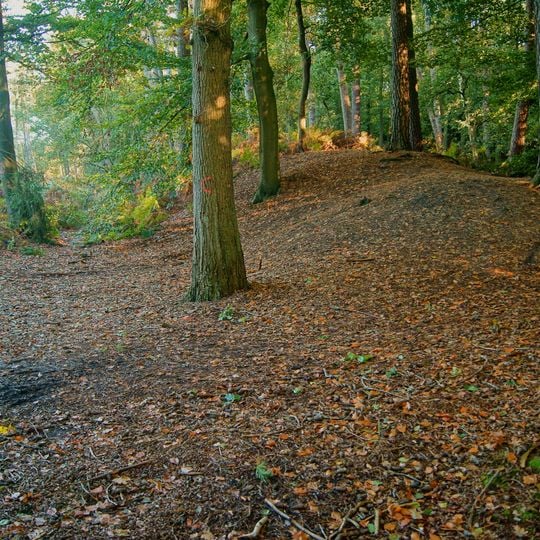
Hünenburg, Archaeological fortification in Stadtlohn, Germany.
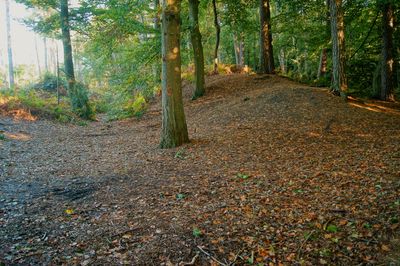
Hünenburg is an archaeological fortification near Stadtlohn consisting of two concentric earthwork walls that enclose a substantial area. The outer and inner earth walls remain visible today and shape the landscape around the Berkel River.
No written sources record its origin or first owners. Finds and excavations suggest a Carolingian earthwork from the second half of the 8th century, matching other fortifications of Charlemagne's Saxon Wars; it may have guarded the Hellweg road near Santforde. The inner enclosure appears younger, possibly late Carolingian or Ottonian, and the site was repeatedly rebuilt. The ground had earlier served as a Bronze and Iron Age urn burial field.
The name Hünenburg refers to giants in German folklore, and locals also call it Wittekindsburg after the Saxon leader Widukind. The site lies in the Bockwinkel, a wooded area near the Berkel, about three kilometres northwest of Stadtlohn's centre. A metal plaque on a boulder near the former gate explains the earthworks to visitors.
The gap in the inner rampart lies in the southeast, where the walls are drawn inward at the site of a former pincer gate; a boulder with a metal plaque marks the spot. The outer rampart is interrupted in the west by a farm, so approach from the southeast. A small stream runs below the inner wall on the west side.
The site sits on ground used as an urn burial field in the Bronze and Iron Ages, long before the ramparts were raised. The inner enclosure is the later element, probably late Carolingian or Ottonian, built inside the older outer works.
The community of curious travelers
AroundUs brings together thousands of curated places, local tips, and hidden gems, enriched daily by 93,951 contributors worldwide.