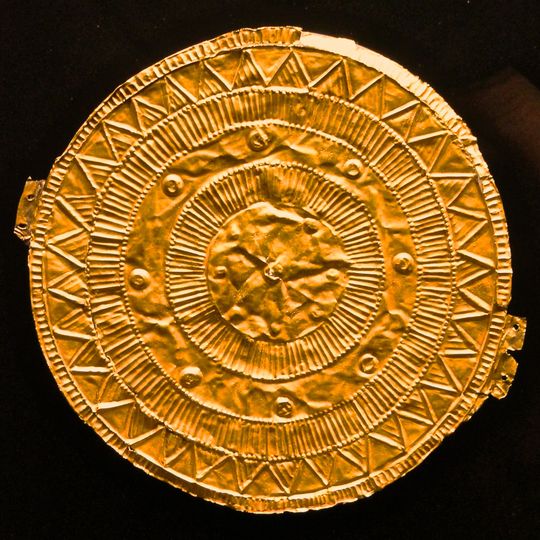
Goldscheibe von Moordorf, Bronze Age gold disk in Aurich, Germany
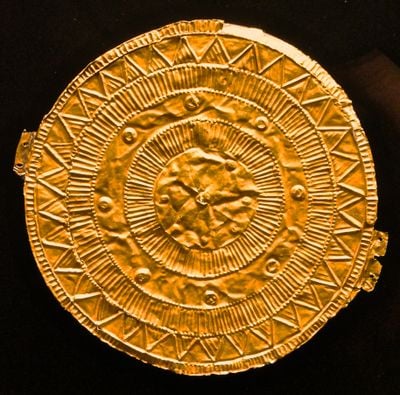
The Goldscheibe von Moordorf is a thin, circular gold disk from the Bronze Age, found near Aurich in Lower Saxony. It is about 14.5 centimeters (5.7 inches) across and decorated with geometric patterns pressed into the metal from the back.
The disk was found by chance in 1910 during peat cutting in Moordorf and was not immediately recognized as an archaeological object. It was later identified as a Bronze Age find and transferred to a museum, where it has been studied ever since.
The disk shows geometric patterns pressed into the gold from the back, a technique also seen on other Bronze Age objects found across Northern Europe. For anyone interested in early metalwork, it offers a close look at how craftspeople shaped and decorated gold at that time.
The disk is held at the Lower Saxony State Museum in Hannover, where it can be seen in person. A visit pairs well with the museum's other prehistoric finds from the region.
Modern scientific tests have raised doubts about whether the disk is genuinely from the Bronze Age, and researchers have not yet reached a firm conclusion. This open question makes it one of the few gold objects in a German museum whose origins are still actively debated.
The community of curious travelers
AroundUs brings together thousands of curated places, local tips, and hidden gems, enriched daily by 92,087 contributors worldwide.