Ofnethöhlen, Prehistoric cave complex near Nördlingen, Germany
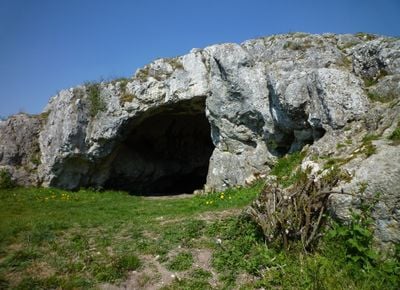
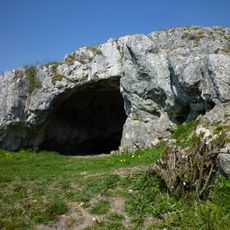
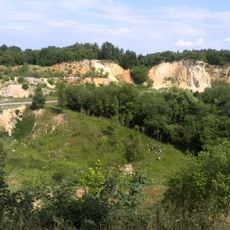
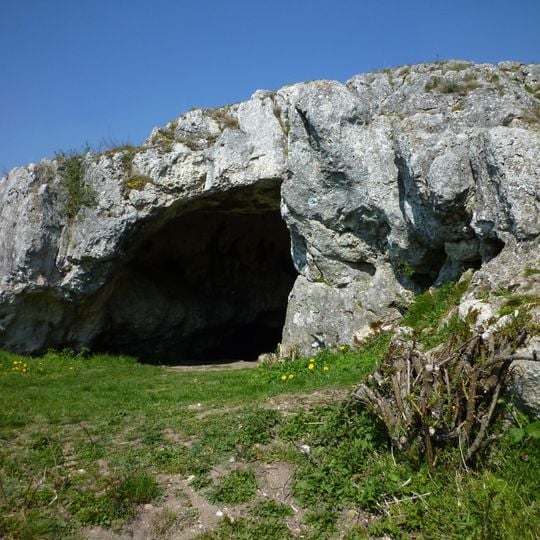
The Ofnethöhlen is a cave system divided into two sections, the Big Ofnet and Small Ofnet, located on the rim of the Nördlinger Ries crater. The site sits within rocky terrain marked by steep slopes and distinctive rock formations that make it identifiable from the walking path.
The caves are the remains of an underground karst system at the edge of the Nördlinger Ries, a limestone ridge also called Himmelreich. Oscar Fraas first examined them systematically in 1875–1876, finding stone tools and animal bones. In 1901–1908 Robert Rudolf Schmidt uncovered two pits in the Grosse Ofnet holding 33 human skulls, later radiocarbon-dated to about 7700 BC.
The name "Ofnet" has no documented origin. The 1908 find in the Grosse Ofnet was two dish-shaped pits holding 33 skulls, 27 in the larger and 6 in the smaller, set concentrically with faces toward the setting sun under red ochre. Female skulls carried 215 perforated deer teeth and 4,250 snail shells, once strung as chains or nets. The finds are shown in Nördlingen's city museum and in Munich.
The caves are reached by a 15-minute walk from a parking area near an ancient Roman estate, located approximately 5 kilometers before entering Nördlingen. Sturdy footwear is important because the path crosses rocky and sloping terrain with natural obstacles.
The caves are the remains of an underground karst system on the rim of the Nördlinger Ries, a limestone ridge nearly two kilometres long that is also called "Himmelreich". The US astronauts of Apollo 14 and Apollo 17 visited them during geological field training in the Ries.
The community of curious travelers
AroundUs brings together thousands of curated places, local tips, and hidden gems, enriched daily by 93,972 contributors worldwide.