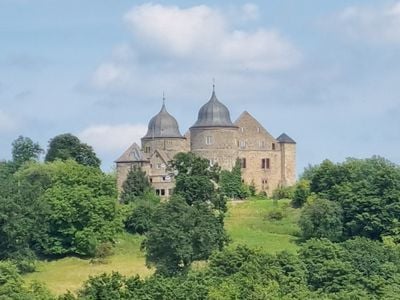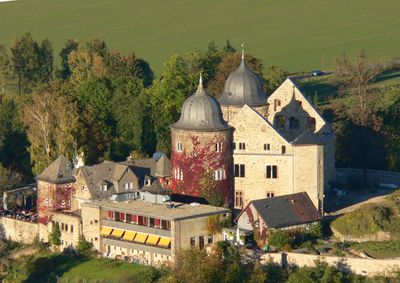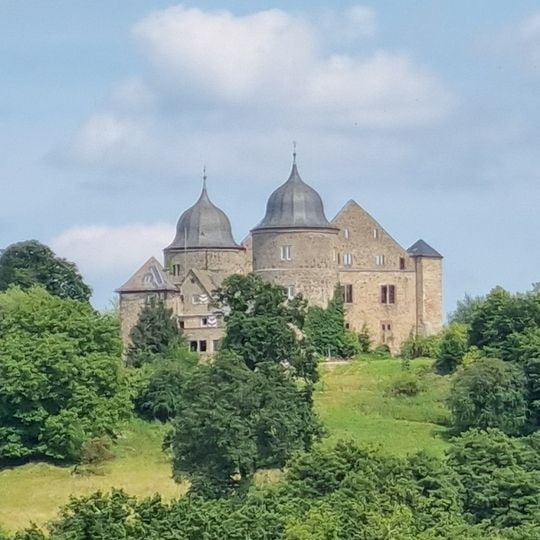
Sababurg, Castle ruin in Hofgeismar, Germany
Sababurg is the ruin of a hill castle on a basalt knoll about 315 m above sea level in the Reinhardswald. Two round corner towers with dark bell-shaped domes and a small stair tower survive, along with the outer walls of the palas, parts of the ring wall with flanking gate, and the 1582 chancellery building. The west, east and south wings were demolished between 1824 and 1826.
Construction of the Zappenburg began on 19 April 1334 under the Bishopric of Mainz, funded by income from pilgrims to Gottsbüren, where the uncorrupted body of Jesus was said to have been found in 1330. Arnold von Portenhagen became its first Burgmann in 1336. After Mainz's defeat in 1346 the castle was divided between Hesse and Paderborn, and in 1462 it passed entirely to Hesse. From 1490 Landgrave William I built a hunting lodge, the Zapfenburg, on the old foundations; the name Sababurg first appears in 1582.
The castle's popular name, Sleeping Beauty Castle, comes from the Brothers Grimm tale, which locals linked to the overgrown ruin after the tales spread from 1812. The SabaBurgTheater is housed in the complex, but since the 2018 closure events have been limited; some are planned for 2026.
The grounds are open to visitors on weekends and public holidays, allowing access to forest pathways around the site. Comfortable shoes are advisable since the terrain is hilly and some paths can be uneven.
The castle became Germany's first municipal wedding venue outside traditional town halls in 1987, attracting couples seeking an uncommon setting for their ceremonies. This unconventional use has given the site a distinctive character that sets it apart from typical historical sites.
The community of curious travelers
AroundUs brings together thousands of curated places, local tips, and hidden gems, enriched daily by 94,096 contributors worldwide.