Teufelsgrabenbrücke, Arch bridge and aqueduct in Valley, Bavaria, Germany
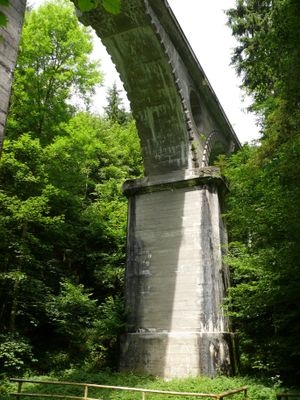
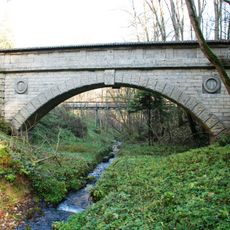
The Teufelsgrabenbrücke is a 91 m long, roughly 19 m high stamped-concrete arch bridge at Grub in the municipality of Valley, built to carry a Munich drinking-water pipeline over the Teufelsgraben. Its four semicircular arches each span 14 m, and the 2.8 m wide structure is monolithic, with no joints or hinges along its length. The concrete imitates rustication, and the keystones bear the Munich coat of arms with the Münchner Kindl.
The Teufelsgrabenbrücke was built by Dyckerhoff and Widmann in Stampfbeton (rammed concrete) without reinforcement and completed on 24 November 1890. It carried a long-distance water pipeline supplying Munich across the Teufelsgraben. Since 1998 a buried conduit (Düker) has taken over the aqueduct's function. In 2010 the city of Munich applied to demolish the bridge, which is a protected monument.
The concrete was finished with a rusticated imitation, giving the 1890 structure the look of dressed stone. Each of the four arch keystones bears Munich's coat of arms with the Münchner Kindl, the city's emblem, marking the bridge as part of Munich's water supply works.
The structure is accessible by following valley trails that wind through the landscape and provide good viewing angles from different positions. Year-round access is available, though wet weather can make the surrounding slopes slippery underfoot.
The bridge is monolithic, with no joints or hinges along its entire length. The concrete was finished with rustication to imitate stone, and each arch keystone bears Munich's coat of arms, the Münchner Kindl. In 2010 the city of Munich applied to demolish the bridge; bridge engineers and the municipality of Valley opposed this and launched a call to keep it as a technical monument of early concrete construction.
The community of curious travelers
AroundUs brings together thousands of curated places, local tips, and hidden gems, enriched daily by 93,111 contributors worldwide.