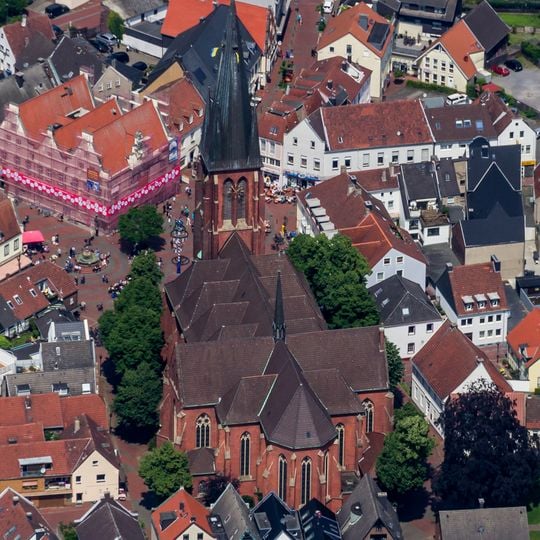
St. Sixtus, Gothic Revival church in Haltern am See, Germany.
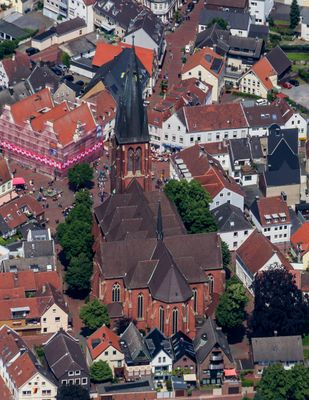
St. Sixtus is a large Gothic Revival hall church built of red brick, with a steep slate roof and an 80-metre square tower topped by a central spire and four corner pinnacles. Its four three-aisled nave bays lead to a transept with a square crossing, followed by a short bay and a choir ending in a 5/8 polygonal apse. Tall pointed windows and brick buttresses line the nave, and the tower carries paired arched belfry openings and a clock.
Haltern is counted among the original parishes of the Diocese of Münster, founded in 804, and a Romanesque predecessor from around the 11th century stood here until the second half of the 14th century, when a Gothic hall church replaced it, keeping only the tower. That medieval church was demolished in 1875; the Münster architect August Hanemann designed the present building, consecrated on 16 September 1885. Because of the shape of the plot it faces south rather than east.
The church's name comes from Saint Sixtus, a patronage otherwise unknown in the Diocese of Münster. Its most important artwork is the Halterner Kreuz, an oak fork crucifix with an expressive figure of Christ carved around 1330/40; since the mid-18th century it has been the goal of pilgrimages. The legend says it was once found in the Lippe, floating upstream. The high point of the Kreuz-Wallfahrt is the Kreuztracht on the Sunday after the Feast of the Exaltation of the Cross.
The church is not oriented east like older churches but faces south, because the plot shape forced this when it was rebuilt in the 1880s. The 80-metre tower with its four corner turrets marks the entrance side, so visitors arriving from the town centre should look for the portal beneath the clock.
The most important item inside is the Halterner Kreuz, an oak fork crucifix with an expressive figure of Christ carved around 1330/40. Since the mid-18th century it has been the goal of pilgrimages, and legend says it was once found in the Lippe, floating upstream. The high point is the Kreuztracht on the Sunday after the Feast of the Exaltation of the Cross.
The community of curious travelers
AroundUs brings together thousands of curated places, local tips, and hidden gems, enriched daily by 93,724 contributors worldwide.