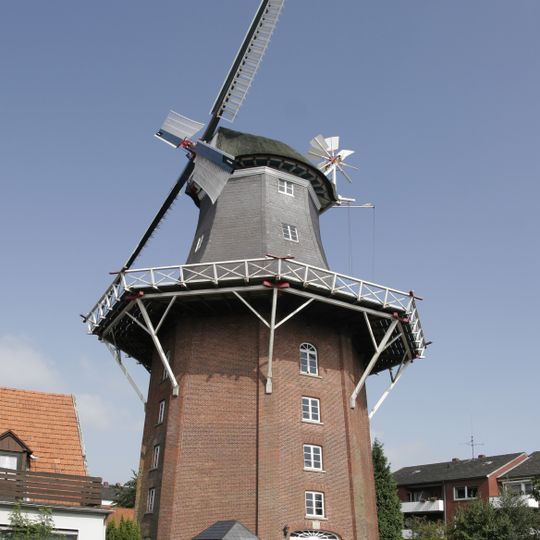
Windmühle Varel, Windmill in Varel, Germany
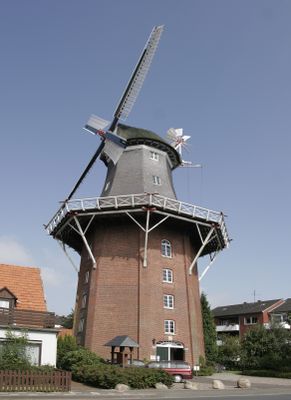
The Varel Windmill, called "Grode Möhl" locally, is a Dutch gallery mill: a brick base of five storeys with 552 m³ of clinker masonry, an octagonal wooden section, and a reed-thatched cap. It measures 29.80 m to the cap tip and 39 m with a sail upright; each sail has a 12 m radius. A gallery at about 15 m serves as a viewing platform, and the mill houses over 2,000 exhibits of local history.
Gustav Adolf von Bentinck, the last count of Varel, had the mill built in 1847–1848; in 1854 it passed to the Grand Duchy of Oldenburg. In 1919 it gained an automatic wind-direction system with a 4.5 m windrose and adjustable louvred sails, replacing manual setting and canvas cloth. Milling stopped in 1965; the town of Varel bought it in 1972 and restored it to working order in 1973–1974.
The building holds a collection of agricultural and fishing tools from the region, showing how people worked in earlier times. The exhibition also documents flood management and dike systems, which were essential for this flat coastal area.
The site is best visited on weekends or during special opening times, which you should confirm in advance. Since access is not guaranteed every day, it is worth contacting the site beforehand to plan your visit.
Inside the mill sits an exceptionally large millstone about 2 meters across, considered one of the largest of its kind in Germany. This massive stone shows what kind of power and craftsmanship were needed to build and operate grain mills on this scale.
The community of curious travelers
AroundUs brings together thousands of curated places, local tips, and hidden gems, enriched daily by 93,368 contributors worldwide.