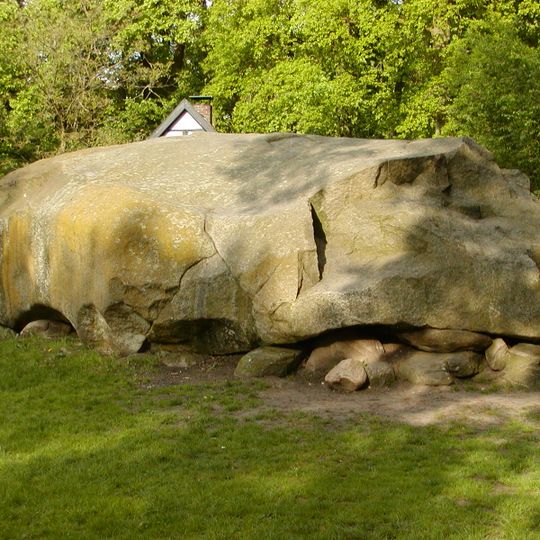
Großer Stein Tonnenheide, Natural monument in Rahden, Germany.
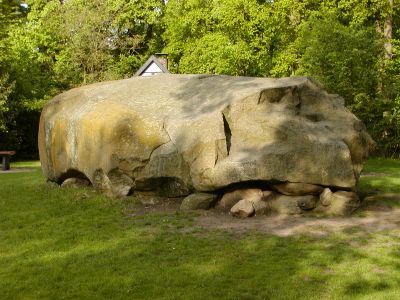
Großer Stein Tonnenheide is a glacial erratic of biotite granite in the Tonnenheide district of Rahden. The block measures 10 meters long, 7 meters wide and 3 meters high and weighs around 350 tons. Blasting marks show that at least 20 cubic meters were once removed from it.
During the Saale glacial period, glaciers carried this massive granite boulder from Blekinge in Sweden approximately 615 kilometers to its current location in Rahden. The stone was detached from its bedrock and deposited by glacial forces over thousands of years.
The stone's name refers to the Tonnenheide hamlet in Rahden, and it stands as a local landmark beside the road. Visitors often walk the roughly 70 metres from its original resting place to the present position, where it was set down in 1981 after two cranes lifted it.
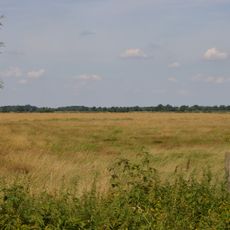
The stone stands about 70 metres from where it was lifted in 1981, in the Tonnenheide district of Rahden. Visitors reach it on foot from the surrounding lanes; the ground is open farmland, so sturdy shoes help after rain. The boulder is freely visible at any time, and its extraction marks can be examined up close.
The boulder displays extraction marks on its surface, showing that at least 20 cubic meters of material were removed from it over the centuries. These carved traces reveal how earlier generations quarried stone from this glacial erratic for building purposes.
The community of curious travelers
AroundUs brings together thousands of curated places, local tips, and hidden gems, enriched daily by 94,035 contributors worldwide.