Grube 7, Limestone quarry in Mettmann, Germany
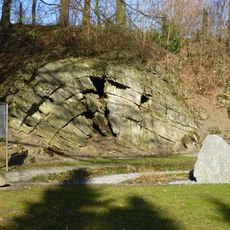
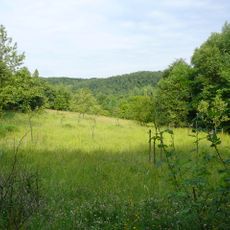
Grube 7 is a former limestone quarry on the eastern edge of Haan, bordering the Osterholz forest and the Wuppertal city line. Dolomitised mass limestone was cut from the Gruiten-Dornap ridge; today secured paths run along the quarry rim past viewpoints, and the floor has largely grown over since the pit lake dried up.
Grube 7 was opened in 1899 on the site of an older small quarry near Gruiten. Its dolomitized mass limestone was first used as furnace additive for blast furnaces in Haan and surroundings, carried by cable and mine railway to Gruiten, then partly by works railway through the Düsseltal to Erkrath-Hochdahl and partly to the lime-sinter works near Gruiten station. After a tunnel was built at Gruiten, lorries took over transport in the final years. Around 1964 about 250 employees produced 720,000 tonnes of rock annually. Mining stopped in 1966.
The quarry lake, nicknamed "Canyon", was a popular swimming spot despite a ban on entry, reached through an overgrown garden at the pit entrance. The Eulenkopfweg and other Haan walking routes now pass through the quarry, and volunteers from AGNU Haan maintain the meadows.
The site is easy to visit as marked trails run along the quarry edges with secured viewpoints for safety. Wear sturdy shoes and bring weather protection since paths cross uneven ground and exposed areas.
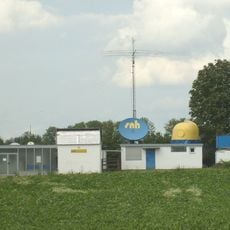
After quarrying ended in 1966, groundwater from the Hahnenfurth pit was piped via the Grenzbach into the Düssel, drawn off again at Grube 7 and pumped into the quarry to seep into the aquifer. A control station in the Dornap lime works monitored temperature, pH, conductivity, turbidity and UV absorption. The pit lake, nicknamed "Canyon", dried up completely when this recharge stopped at the end of the 20th century.
The community of curious travelers
AroundUs brings together thousands of curated places, local tips, and hidden gems, enriched daily by 94,522 contributors worldwide.