Grundloses Moor, Nature reserve in Walsrode, Germany.
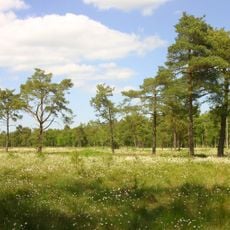
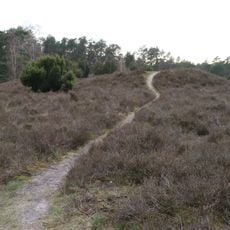
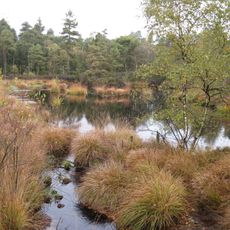
Grundloses Moor is a 295-hectare nature reserve centred on the Grundloser See, a 2.5-metre-deep bog pond 435 metres long and up to 160 metres wide. The moor fills the northeastern half of a 4-kilometre-long depression between two parallel end moraines from the Saalian glaciation. Cottongrass, cranberries, bilberries, peat moss and cross-leaved heath cover the bog, which is drained by a ditch forming the upper Fulde.
This moorland was formed during the Saalian glaciation period thousands of years ago when glaciers shaped the landscape. Two parallel end moraines created a depression that gradually filled with water, eventually developing into the bogland we see today.
The name Grundloses Moor means "Bottomless Bog", and the lake at its centre is called Grundloser See. The nature reserve, designated on 30 July 1990 under the code NSG LÜ 185, is managed by the Heidekreis district. Visitors can see cottongrass, cranberries, bilberries, peat moss and cross-leaved heath, with large stands of bog bilberry.
The lake can be circled close to its shore, starting from hikers' car parks east at Ebbingen and south north of Fulde. The Grundloser See is not suitable for bathing. The moor is drained by a ditch forming the upper course of the Fulde.
The Grundloser See began as a nearly silted-up residual lake from the ice age; it survives today because peat growth dammed it and because of a process of raised-bog pool formation. About 400 metres to the northeast lie the Kleiner See, roughly 60 metres across, and two other small water bodies.
The community of curious travelers
AroundUs brings together thousands of curated places, local tips, and hidden gems, enriched daily by 94,640 contributors worldwide.