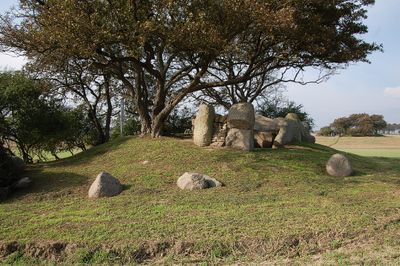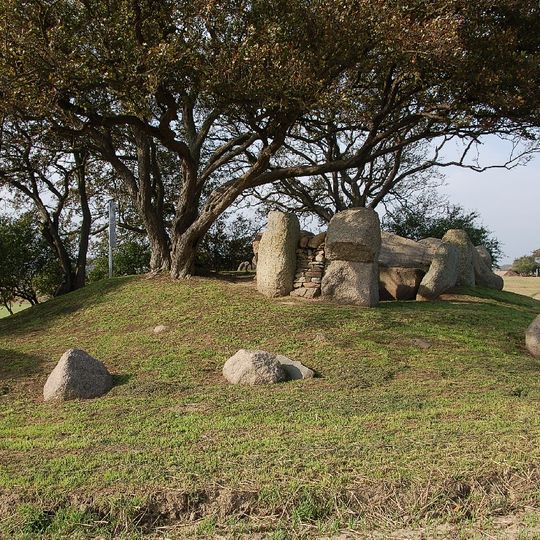
Großsteingrab Gaarzer Hof 1, Neolithic passage grave near Rerik, Germany.
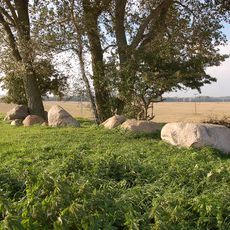
Großsteingrab Gaarzer Hof 1 is a megalithic burial structure built from stone slabs arranged in a burial chamber form. The monument sits within open fields and consists of supporting stones that once held capstones above a chamber space now partially exposed to the elements.
Both tombs were built between 3500 and 2800 BC by the Funnel Beaker Culture. The passage grave (Sprockhoff no. 327) was later reused by bearers of the Single Grave Culture, whose pottery and amber beads were found on its clay floor. Adolf Hollnagel examined the passage grave and Ewald Schuldt the large dolmen, both in 1967.
The two tombs lie in open farmland south of the Kröpelin–Rerik road, about 100 m apart, where a lane branches off toward Neu Gaarz. The passage grave was reused by bearers of the Single Grave Culture, who left their own pottery and amber beads in the chamber. Fieldstones and earth were used in the mounds, and the dolmen's chamber floor was burned red during the Neolithic.
The two tombs lie in open fields south of the Kröpelin–Rerik road (L122), about 100 m apart, where the lane to Neu Gaarz branches off. Park at the roadside and walk in; the ground around the stones is uneven grass. The site is unenclosed and has no facilities, so bring water and weatherproof footwear.
The passage grave's floor was made of clay plaster, and excavation yielded 332 pottery sherds, 16 transverse arrowheads, three amber beads (one double-axe shaped) and two flat axes. The chamber was later reused by people of the Single Grave Culture, whose four cups were found inside.
The community of curious travelers
AroundUs brings together thousands of curated places, local tips, and hidden gems, enriched daily by 92,853 contributors worldwide.